
Step 9: Set Environmental Objectives and Action Plan
Setting Environmental Objectives
Organizations need to establish environmental objectives describe specific outcomes that are developed to achieve overall EMS policy goals. The objectives should be consistent with the organization’s environmental policy, compliance obligations, and environmental aspects and impacts, as well as the views of interested parties.
Environmental objectives include two components:
- a goal component stating a general outcome, such as, "reduce the amount of fuel use;" and
- a target component stating a specific, quantifiable, time-limited, change such as, "by 5% within two years."

The objective's goal and target statements are designed to decrease negative aspects and impacts or increase positive impacts.
Let's say your facility generates hazardous waste. Your stated environmental objective is to reduce the level of hazardous waste generation by 10% by the year 2024. Your goal statement is to "reduce hazardous waste generation at the plant," and the target statement is, "by 10 percent by the year 2024."
When you set objectives, it is important to make sure you're able to track and measure performance or progress. Then, during each stage of the EMS process, you can report on the progress made toward achieving the objectives.
SMART Objectives
Ideally, the objectives should be "SMART."
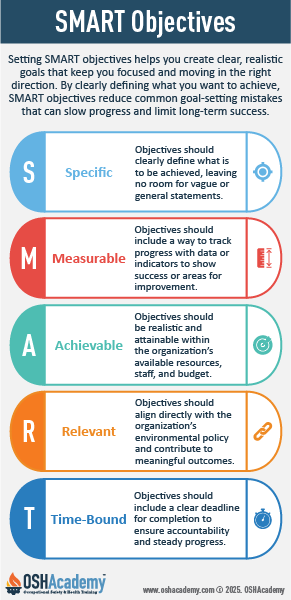
- Specific: Objectives should clearly define what is to be achieved, leaving no room for vague or general statements.
- Measurable: Objectives should include a way to track progress with data or indicators to show success or areas for improvement.
- Achievable: Objectives should be realistic and attainable within the organization’s available resources, staff, and budget.
- Relevant: Objectives should align directly with the organization’s environmental policy and contribute to meaningful outcomes.
- Time-bound: Objectives should include a clear deadline for completion to ensure accountability and steady progress.
Examples
- Within six months, decrease electricity use in office buildings by 10% through installation of energy-efficient lighting and staff awareness programs.
- Within the next 12 months, increase the percentage of environmentally preferred products purchased by 20% compared to the previous year.
Each Environmental Objective must be traceable back to the Environmental Policy statement. In order to be acceptable under the ISO 14001:2015 standard every action, requirement, procedure, etc., contained within the environmental management system must have its roots in the Environmental Policy statement.
It's important to remember that if you can't trace specific environmental objectives back to the Environmental Policy statement it must be assumed that the Environmental Policy statement is not accurate.
Knowledge Check Choose the best answer for the question.
3-5. Complete the following objective with a specific target component: "Reduce the amount of paper waste _____."
You forgot to answer the question!