
Improving the EMS (Steps 23-27)
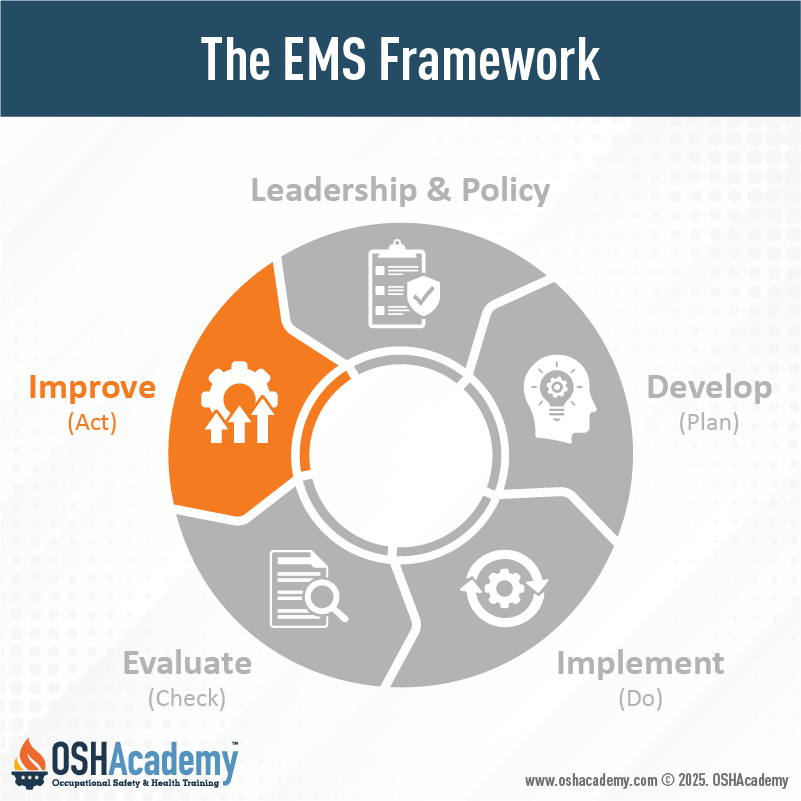
The next phase of the PDCA cycle is “ACT.” During this phase, the organization fixes and improves its EMS. For example, the organization may execute corrective action plans and make necessary updates to improve performance.
Step 23: Establishing and Implementing Corrective Action Plans
During the "CHECK" phase in Step 20, the EMS team looks for nonconformances or ways in which the organization is not meeting EMS requirements or satisfying environmental objectives and obligations. For example, the team may detect problems through internal audits, compliance evaluations, emergency drills, real-world emergencies, facility inspections, and staff or stakeholder surveys.
Nonconformance and Corrective Action
When a nonconformance is identified, the EMS team must correct it and mitigate resulting environmental impacts. First, the team should identify the cause of the nonconformance so that it will be able to prevent reoccurrence. Then, the team should identify an appropriate corrective action, document it in a corrective action plan and fix the issue.
A competent person should be assigned the responsibility and authority to track nonconformance and assure corrective action. Corrections should be made as quickly as possible. People in affected areas should be encouraged to report existing and potential problems.
Procedures should be developed to correct the nonconformity. The procedures will vary with the specific problem and should be kept as simple as possible. For instance, the procedures should not be rewritten every month when all that is needed is to provide better training. On the other hand, procedures must be adequate to cover critical issues.
Corrective Action Plan Elements
An effective corrective action plan should include the following elements:
- Identification of the nonconformance and any associated risks to the environment.
- Root cause analysis to determine why the nonconformance occurred.
- Specific corrective steps to eliminate the problem and prevent recurrence.
- Assignment of personnel responsible for implementing each step.
- Timelines for completion of each corrective action item.
- Methods for verifying that the corrective actions were implemented and are effective.
The EMS team should review the effectiveness of the corrective actions after implementation. If a corrective action fails to solve the problem or prevent it from happening again, the team must reassess the situation and develop a revised plan. This step helps support continuous improvement throughout the EMS.
Encouraging a Culture of Reporting
All staff must understand the importance of identifying and reporting nonconformances. A no-blame culture, where employees are not punished for identifying problems, helps ensure that issues are reported early. Early detection of issues makes corrective actions more effective and helps reduce negative environmental impacts.
Examples of Nonconformances and Corrective Actions
| Nonconformance | Cause | Corrective Action |
|---|---|---|
| Improper waste sorting: an internal auditor found recyclables in landfill-bound trash | Office staff don't know what is recyclable and what is not |
Conduct training for staff Develop clear signage and appropriate labels to post on or next to bins |
| Improper labeling of hazardous waste: an auditor found hazardous waste collection containers missing accumulation start date | New onsite contractor responsible for waste collection was not properly trained in labeling containers | Update contract language to ensure that all contract employees receive RCRA hazardous waste management training and hazard communication training |
Knowledge Check Choose the best answer for the question.
6-1. What is the main purpose of a corrective action plan in an EMS?
You forgot to answer the question!