
Circulating and Cementing
After the casing has been run and properly landed in the wellbore, drilling fluid is circulated through the casing and up the annulus. This circulation removes residual gases, cleans the wellbore, and conditions the drilling mud in preparation for cementing operations.
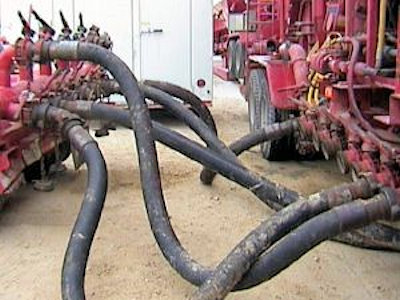
Once circulation is complete and the mud is properly conditioned, cementing operations begin. Oilfield cement is a powdered material composed primarily of alumina, silica, lime, and other additives. When mixed with water, it forms a slurry that hardens and bonds the casing to the walls of the wellbore, providing zonal isolation and structural support.
During cementing, the casing may be reciprocated or rotated to allow scratchers to remove excess wall cake from the formation. This process improves cement bonding and helps ensure a reliable cement sheath around the casing.
Cementing operations are typically performed by a specialized service company. Close coordination between the drilling crew and cementing personnel is essential to manage high-pressure pumping operations and associated hazards.
Potential Hazards
- Being struck by high-pressure lines or hoses if they fail, rupture, or are not properly secured.
- High-pressure connection failures caused by mismatched, damaged, or excessively worn hammer unions.
- Exposure to cement dust or wet cement, which can cause skin irritation, burns, or respiratory issues.
- Slips and trips due to cement slurry, drilling fluids, or hoses crossing work areas.
Possible Solutions
- Properly hobble and restrain all high-pressure lines to prevent uncontrolled movement in the event of failure.
- Inspect high-pressure lines, hoses, and hammer unions prior to use, paying special attention to wear, cracks, mismatched pressure ratings, and compatibility (note that 602 and 1502 unions may connect but cannot safely withstand higher pressure ratings).
- Ensure all high-pressure connections are compatible, properly rated, and securely tightened before pressurizing.
- Require appropriate Personal Protective Equipment (PPE), including eye protection, gloves, protective clothing, and respiratory protection when cement dust is present.
- Stay current with safety alerts, manufacturer recommendations, and company procedures related to high-pressure pumping operations.
- Establish exclusion zones around pressurized lines and restrict access during cementing operations.
Knowledge Check Choose the best answer for the question.
7-5. According to the text, which of the following is a hazard while circulating mud and cementing the wellbore?
You forgot to answer the question!