
Resuming Drilling
After a new joint of pipe has been made up and the kelly and drill string are properly aligned, drilling operations resume. In this process, the driller starts the mud pumps to reestablish circulation and carefully picks up the drill string off the slips.
This transition marks the return to active drilling and requires close coordination between the driller and the floor crew to ensure equipment is properly engaged and personnel are clear of rotating and moving components.
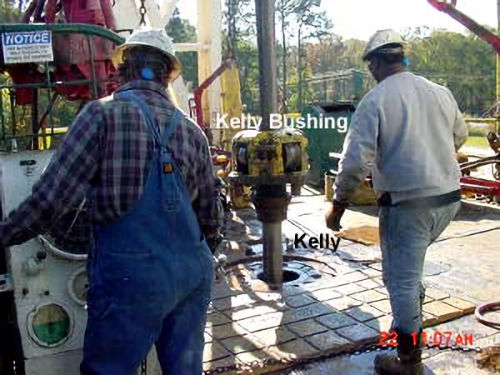
The crew resumes lowering the kelly bushing and reengaging the drill string.
- The drill crew removes the slips once the drill string is properly supported by the hoisting system.
- The driller lowers the drill string until the kelly drive bushing fully engages the master bushing.
- After the bushings are engaged, the driller begins rotating the drill string, lowers the bit back to bottom, and continues drilling the hole.
Potential Hazards
- Being thrown off balance or struck by moving equipment when the rotary table or top drive begins to rotate. Sudden movement of the drill string, kelly, or rotary equipment can catch workers off guard, causing them to lose their balance or be struck by moving components.
- Getting caught in rotating equipment if loose clothing, gloves, jewelry, long hair, or unsecured personal items become entangled in the rotating drill string, kelly, rotary table, or top drive. Entanglement can result in serious injuries, including amputations or fatalities.
- Pinch-point hazards when removing slips, engaging the kelly drive bushing with the master bushing, or working near other moving equipment. Hands and fingers can be pinched or crushed between slips, bushings, pipe, or other rig floor components if workers are not properly positioned.
Possible Solutions
- Stand clear of rotating equipment and moving drill string components whenever the rotary table or top drive is engaged to prevent being thrown off the rotary table. Do not step onto or reach across rotating equipment, and never attempt to adjust or handle equipment while it is in motion.
- Maintain proper footing and stay outside designated red or restricted zones. Ensure the rig floor is clean and free of mud, drilling fluid, tools, and other trip hazards. Only essential personnel should be in the work area during startup, and everyone should remain alert to changing conditions.
- Prevent entanglement and pinch-point injuries by securing loose clothing, tying back long hair, removing jewelry and other dangling items, and avoiding gloves or other items that could become caught in rotating machinery when required by company procedures. Keep hands and fingers away from bushings, slips, and other pinch points, and maintain clear communication between the driller and floor crew before and during startup so everyone knows when equipment will begin moving.
Knowledge Check Choose the best answer for the question.
5-7. Why should workers stand clear whenever the rotary table or top drive is engaged?
You forgot to answer the question!