
The Continual Improvement Process
Developing an Environmental Management System (EMS) might sound like an overwhelming task for a smaller organization, but it need not be. When the process is completed in a step-by-step manner, any organization can tackle it. The EMS is composed of two closely related development approaches: the "PDCA Cycle" and the "Framework."
PDCA Cycle
The Plan-Do-Check-Act (PDCA) Model
There are several models that can be used to develop, implement and maintain an EMS. This course uses the model described by the ISO 14001 Standard, which was developed by the International Organization for Standardization (ISO) and builds on an approach developed many years ago by quality experts. It focuses on continual improvement through an ongoing cycle of actions called the Plan-Do-Check-Act (PDCA).
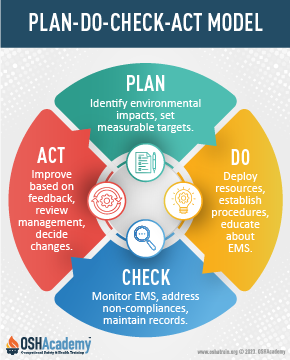
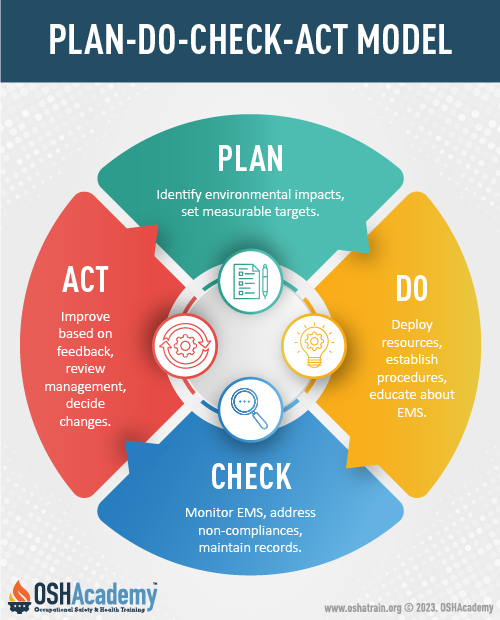
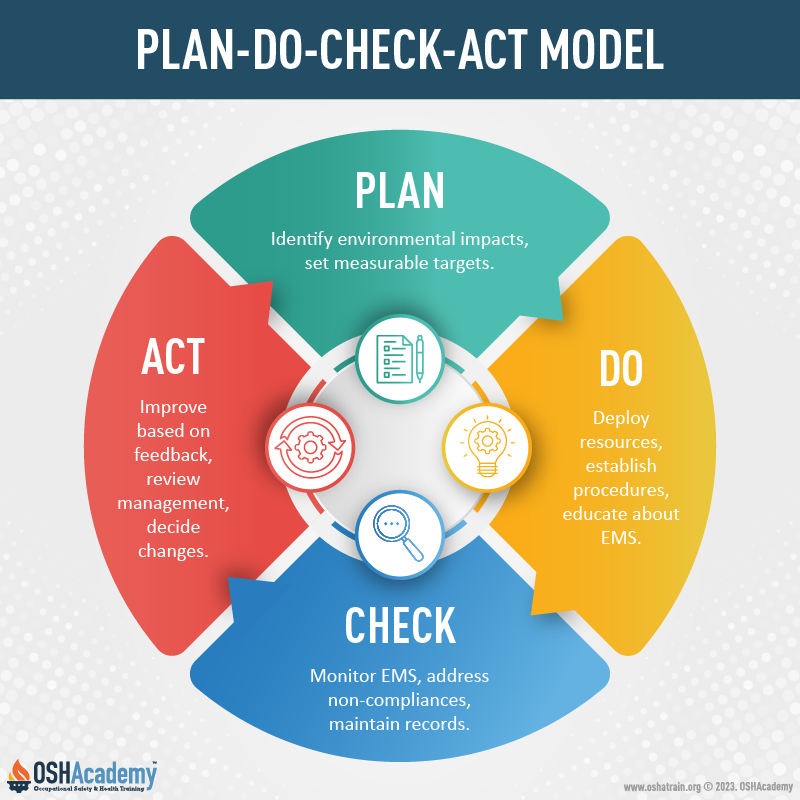
The diagram illustrates the clockwise never-ending continual improvement process. Briefly, each of the four steps in the cycle involve:
- Plan: During this first phase, an organization identifies and establishes various parts of its EMS. For example, the organization identifies the ways that its operations may impact the environment (e.g., environmental aspects) and establishes detailed environmental goals (or environmental objectives).
- Do: During this phase, the organization implements various parts of its EMS. For example, it may implement operational controls to minimize environmental aspects and execute action plans to achieve environmental objectives. If the organization has already established an EMS, this phase may only involve determining whether any changes have occurred since initial EMS development and carrying out new plans or procedures.
- Check: During this phase, organizations evaluate the EMS through internal audits, compliance evaluations, emergency drills, real-world emergencies, facility inspections, and staff or stakeholder surveys. The "environmental indicators" which are measurable metrics discovered during the evaluation provide information on the status of operations. Examples include gallons of water consumed per month, number of compostable items mistakenly thrown in landfill-bound trash (determined by a waste audit), or number of commuting trips made with bicycles rather than single-occupancy vehicles.
- Act: During this phase the results of the "Check" phase are acted upon. If deviations from requirements in the EMS or applicable compliance obligations (nonconformances) are found, the team acts by advancing to the first PDCA "Plan" phase to plan how to correct them. Basically, they start over in the continuous improvement process.
Knowledge Check Choose the best answer for the question.
1-3. What does the acronym PDCA stand for in the EMS continual improvement process?
You forgot to answer the question!