Construction Industry
Construction Industry Safety Training
- Satisfy OSHA training requirements.
- Convenient online training at your own pace.
- Access course materials for FREE.
- No up-front fees or costs!
- Purchase a PDF certificate upon completion.
Which Construction Safety Program is Right for Your Role?
Verified Customer Reviews
Business Benefits

Train your team with less downtime and lower cost—online learning beats classroom training.

Contact us! Our professional customer service team is here to help.

Business clients can save up to 20% off regular pricing.
Features

Download digital (PDF) certificates directly from your training dashboard after making a purchase.

Complete training at your own pace, moving as fast or slow as needed.

Easily verify your certificates online. You can be confident certificates issued by OSHAcademy are legitimate.
Certificate Packages
PDF & Original

Original


Package Includes
- Program Certificate
- FREE† Course Certificates
- FREE† Training Record Card
- FREE† Transcript
Why Register?
When you register for an OSHAcademy student account, you will be able to complete and track your training using our online Learning Management System (LMS). After registering, you will be able to edit your account profile and track your individual training from your personal LMS dashboard. Once you make a payment, you can view exam scores and, if purchased, print your PDF certificates.
It's Fast, Easy, and Safe!
Registering for an account takes only a few minutes and we never sell, share, or trade your personal information with anyone! You control access to your account by creating a personal student ID and password only you know. Click here to view our full privacy policy.
If you are already an OSHAcademy student, you can update your enrollment through your student dashboard. Need help? Call or email or office.
Register Now!Final Course Exams
After enrolling in a course, studying the course material, and completing the knowledge check activities, students may take the course exam. The course exam is designed to test students' understanding of the course material. Course exams consist of multiple-choice questions selected from our extensive question banks.
Exam Characteristics
- Most course final exams consist of 20 questions randomly selected from a question bank.
- You have two (2) hours to complete the course exam.
- The exam is open book. You may use course modules, review notes, or the course study guide to help answer questions.
- You must achieve a minimum score of 70% to pass the exam.
- You may retake the final exam if you do not pass:
- You may take an exam three (3) times within a 48-hour period.
- After the third attempt, students must wait 24 hours before attempting the exam again. During this time, you should review the course material to improve your understanding.
- After each exam, you receive an email with information on missed questions. We encourage you to review the course material to improve your understanding.
- Once you pass the final exam, you may not retake it to raise your score.
The OSHA 10 and 30-Hour outreach training requirements can vary by state, and it's important to note that the mandates often depend on specific sectors, particularly construction. Here is a list of states that have specific requirements for OSHA 10 or 30-hour training for certain workers, mainly in the construction industry:
- Connecticut - Requires OSHA 10-hour training for all employees of any public works project paid for in part or whole by state funding.
- Florida (Miami-Dade County) - Requires OSHA 10-hour construction outreach training for all workers of any public or private building project valued at over $1,000,000.
- Missouri - Requires OSHA 10-hour construction outreach training for public works projects.
- Massachusetts - Requires OSHA 10-hour construction outreach training for workers on publicly funded construction sites.
- New Hampshire - Requires OSHA 10-hour construction outreach training within 30 days of being hired for all employees on publicly funded construction projects of $100,000 or more.
- New York - Requires OSHA 10-hour construction outreach training for all workers on all publicly funded project over $250,000. New York city has additional requirements for construction workers.
- Nevada - Requires OSHA 10-hour construction outreach training for all construction workers and OSHA 30-hour training for supervisors. Also requires OSHA 10-hour construction or general industry outreach training for employees working in the entertainment industry workers and OSHA 30-hour training for supervisors.
- Pennsylvania (Philadelphia) - Requires OSHA 10-hour construction outreach training for workers and OSHA 30-hour training for supervisory employees in construction or demolition activities.
- Rhode Island - Requires OSHA 10-hour construction outreach training for workers on municipal and state construction projects that cost more than $100,000.
- West Virginia - Requires OSHA 10-hour construction outreach training for workers on public improvement projects that cost more than $50,000.
These requirements are typically enforced at the state level and may have specific conditions or exemptions based on the type of work, the funding of the project, and other factors. Always consult local regulations or legal guidance to ensure compliance with current OSHA training requirements in your state.
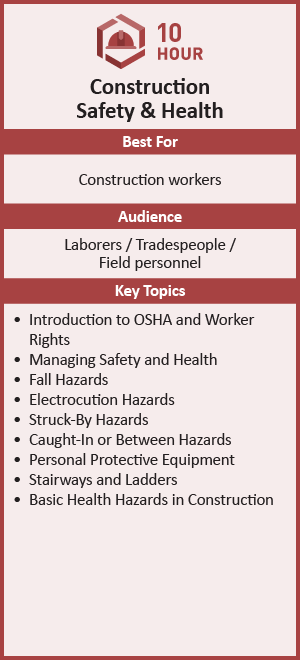
The OSHAcademy 10-Hour Construction Safety and Health program is an entry-level training program designed for construction workers who want to understand workplace hazards, OSHA regulations, and how to stay safe on the job. It is equivalent to the OSHA 10-hour construction outreach course. It covers essential topics like:
- Fall protection
- PPE (personal protective equipment)
- Electrical safety
- Hazard communication
- Introduction to OSHA and worker rights
- Struck-by hazards
- Caught-in or between hazards
- Stairways and ladders
- Basic health hazards in construction
This is the best starting point if you're new to construction or need basic safety awareness.
The OSHAcademy 10-hour Construction Safety and Health program is ideal for:
- New or entry-level construction workers
- Laborers, helpers, and apprentices
- Workers required to complete OSHA training by employers or job sites
No. All of our training is free to access, but once you complete and pay for the training, you will receive an OSHAcademy training record card. If you are required to have an OSHA Outreach card associated with the Department of Labor (DOL), please visit the US Dept of Labor's website.
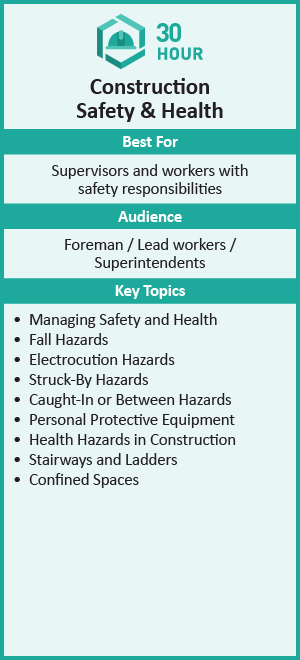
The OSHAcademy 30-Hour Construction Safety and Health program is a more advanced program designed for workers with safety responsibilities. It is equivalent to the OSHA 30-hour Construction Outreach program. It covers essential topics like:
- Introduction to OSHA/worker rights
- Managing safety and health
- Fall hazards
- Electrical hazards
- Struck-by hazards
- Caught-in or between hazards
- Personal protective equipment
- Health hazards in construction
- Stairways, ladders, and elevated access safety
- Confined Space Safety
- Materials Handling Safety
- Scaffold Safety
- Ergonomic Hazards in Construction
- Safety Supervision and Leadership
This course is often required for supervisors, and foremen.
Here's a quick way to decide:
Take the OSHAcademy 10-hour if you are:
- New to construction
- Not responsible for supervising others
- Looking for basic safety training
Take OSHAcademy 30-hour if you are:
- A supervisor or foreman
- Responsible for job site safety
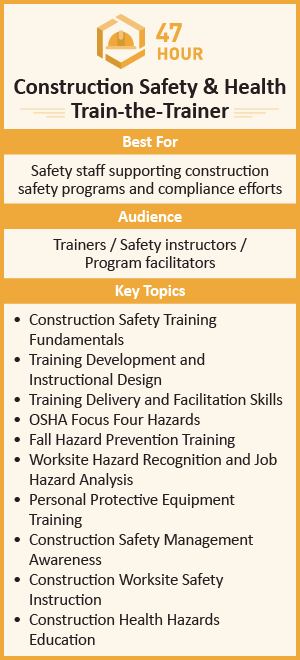
The 47-Hour Construction Safety Trainer program is designed for professionals who want to:
- Teach safety topics at your worksite
- Train employees or teams that work at your company
- Lead safety training within your organization
Training certification, whether it is online or in the classroom, is only the first step toward becoming a qualified safety trainer within a company. You must do more. You may conduct safety training only after you are evaluated, certified, and authorized by your employer to do so. However, it's important for legal reasons that you meet specific criteria that enable the employer to justify certifying you as a qualified safety trainer within the company. To meet the qualifications of certification as a safety trainer in your company, you should:
- have the necessary knowledge, training, and experience, as determined by the employer, in the safety topics being trained
- complete a "Safety Train-the-Trainer" program, such as the OSHACademy 47-hour Construction Train-the-Trainer program
- demonstrate the ability to develop and present training in a manner and in the language that is understood by employees
- have your knowledge, skills, and abilities (KSAs) evaluated by an employer-appointed competent and qualified person
- demonstrate, through evaluation by a competent person, that employees have gained the required KSAs to work in a safe and healthful manner on the job
- receive, from the employer, an official written certification as a qualified safety trainer.
The employer should appoint and formally certify that you have met their requirements as a qualified safety trainer. In effect, you become a certified safety trainer, but the scope of your certification is limited to the company. The certification is not national in scope.
Note: If you are interested in nationally recognized certification as a qualified safety professional/trainer, you need to meet certain experience, educational, and exam requirements from a credentialing organization like the Board of Certified Safety Professionals. The BCSP awards the Certified Instruction Trainer (CIT) to those who qualify.
If you want to read more about becoming an authorized OSHA Outreach Trainer, please click here.
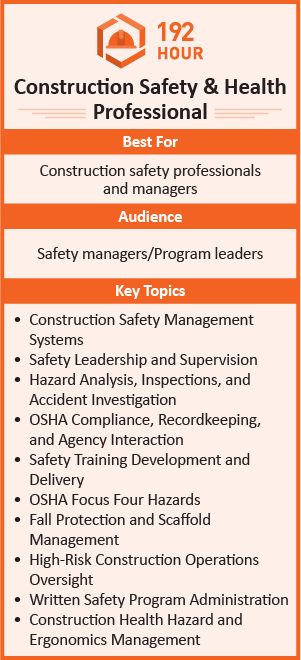
The 192-Hour Construction Safety and Health Professional program is OSHAcademy's most advanced offering for the construction industry. It's designed for:
- Safety managers
- Directors
- Compliance professionals
- Experienced supervisors
This program provides comprehensive, career-level training across many major construction safety topics and leadership principles. It is ideal if you want to move into higher-level safety roles or management. It covers essential topics, such as:
- Construction safety management systems
- Safety leadhership and supervision
- Hazard analysis, inspections, and accident investigation
- OSHA compliance, recordkeeping, and agency interaction
- Safety training development and delivery
- OSHA focus four hazards
- Fall protection and scaffold management
- High-risk construction operations oversight
- Written safety program administration
- Construction health hazard and ergonomics management
OSHA requires employers to provide training to workers who face hazards on the job. Many employers, contractors, and job sites require OSHA training-especially OSHA 10 or OSHA 30.
Even when it's not required, having OSHA training:
- Improves your job opportunities
- Helps you stay safe on the job
- Shows employers you take safety seriously
Yes. OSHA-aligned training programs can be completed online, allowing you to:
- Train at your own pace
- Access materials anytime
- Access training certificates at anytime
- Verify your training at anytime
- 10-hour Construction Safety and Health program: typically completed in 10 hours
- 30-hour Construction Safety and Health program: typically completed in 30 hours
- Advanced programs: completed over a longer timeframe at your own pace
- 10-hour Construction Safety and Health → Get started
- 30-hour Construction Safety and Health → Move into leadership
- 47-hour Construction Train-the-Trainer → Train other employees
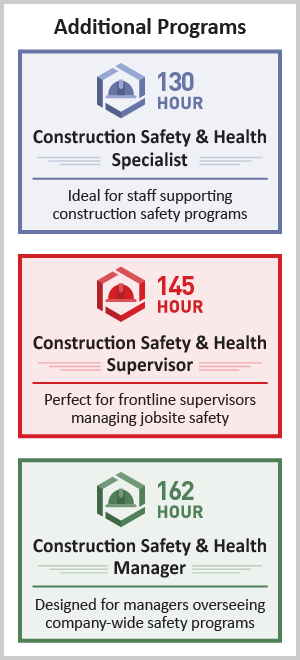
- 130-hour Construction Safety & Health Specialist → Support construction safety programs
- 145-hour Construction Safety & Health Supervisor → Frontline supervisors managing jobsite safety
- 162-hour Construction Safety and Health Manager → Safety managers overseeing company-wide safety programs
- 192-hour Construction Safety and Health Professional → Safety professional, director, or leadership
Construction is one of the most hazardous industries. Proper training helps:
- Prevent injuries and fatalities
- Ensure OSHA compliance
- Protect workers and employers
- Improve job site efficiency
Safety training isn't just required-it's essential.
Yes! Students will retain access to all course materials even after finishing the construcion safety training. This means students can revisit content, resources, and reference documents at any time. Our commitment is to ensure students are equipped with the latest OSHA construction safety standards. This access allows students to refresh their knowledge as needed and stay informed about any updates or changes in regulations.
Participants are allowed to take the test as many times as needed until they pass the course final exams. This ensures that all individuals can achieve a passing score without limits on the number of attempts they can make. Please note: if a student fails the final exam 3 times within 48 hours they must wait 24 hours before attempting the final exam again. During this time, the student should review the course material to improve their understanding.
Yes, if you have purchased a training certificate package before taking the course. Otherwise, if you complete the course and final exam before buying a training certificate package, your exam score will be saved in our training system, allowing you to purchase a training certificate package whenever you choose.
Yes, they are designed to be completely self-paced. You have the freedom to progress through the material on your own timeline, tailoring your study sessions to fit your personal and professional commitments. There's no pressure from strict deadlines, allowing you to move through the course at a speed that best suits your learning style and schedule. This flexibility means you can prioritize your learning alongside other responsibilities, all while gaining essential knowledge at your own pace.
Yes! You have two options:
- Without IACET accreditation: Time tracking will be disabled.
- With IACET accreditation: Time tracking will be enabled, and the IACET logo will appear on your training certificate once you have completed the required time and passed the final exam.
Yes. Students and employers can validate the construction safety training course and program certificates using our website. It's quick and easy! You can feel confident knowing the certificate is valid and was issued by OSHAcademy. To validate your training certificate click here.
It depends on the training topic. To view the full list of OSHA requirements please review OSHA publication 2254 Training Requirements in OSHA Standards.
Yes, the construction safety training is fully accessible on both mobile and tablet devices. This compatibility ensures that you can conveniently access the course materials anytime, anywhere, on the go. Whether you're using an iOS or Android device, the training experience is optimized to provide ease of navigation and a seamless learning process across all screen sizes.
If you are interested in setting up a business or educator account with OSHAcademy you may do so by clicking here. Some of the benefits of a business/educator account are as follows:
- Associate all of your employees with your organization within our training system.
- Designate "managers" that can view/print/save employee's training certificates from their dashboard.
- Reset employee's passwords.
- Add employees to the organization.
- Create teams within your organization.
- Assign "Team Leaders" that can view/print/save training certificates and reset team members passwords.
- Generate Excel training reports.
- Purchase certificates for multiple employees in a single invoice.
- Apply business discounts to invoices if applicable.
Ku·dos
: praise or respect given
The 192-hour Construction Safety and Health Professional Program is a thorough and practical training track for anyone responsible for safety on active job sites. The coursework covers core regulations, hazard identification, incident prevention, and real-world problem solving. The program combines classroom instruction with applied exercises, which makes the material easier to use in the field. It is a strong option for supervisors, safety managers, and anyone who needs a deeper understanding of OSHA requirements and construction safety principles.