
Emergency Response and Planning
First Aid and Emergency Action Plan
Employees showing signs or symptoms of heat illness must be closely monitored and never left alone or sent home without first receiving on-site first aid or emergency medical services. Monitoring should include checking the employee’s heart rate. Avoid taking under-the-tongue temperature measurements, as these can interfere with hydration and may result in inaccurate readings if the employee drinks cold water.
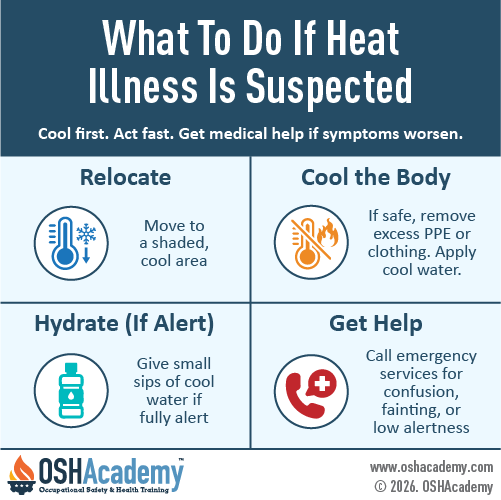
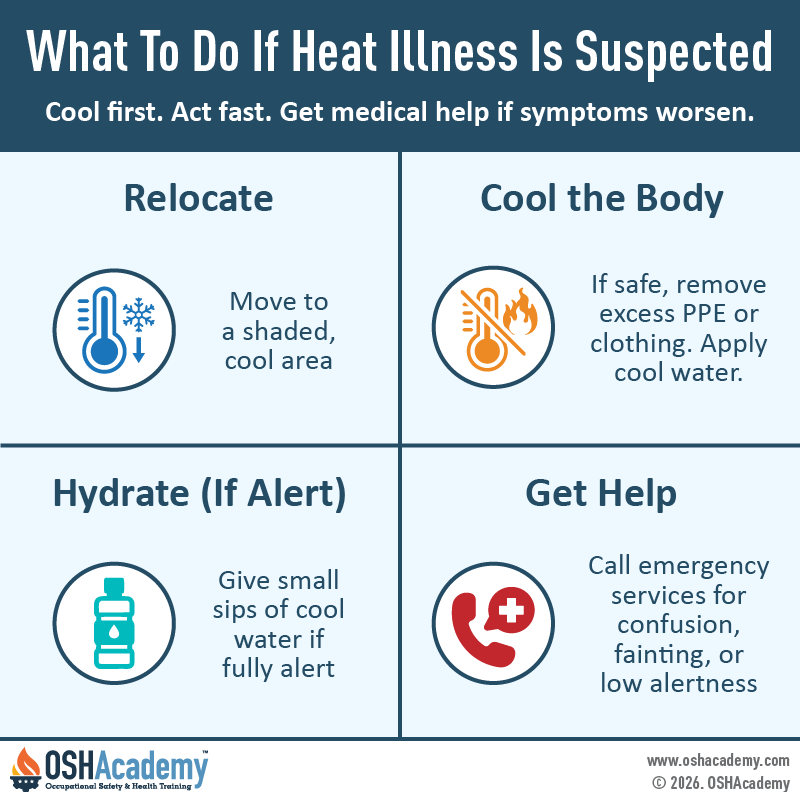
If an employee shows severe heat illness symptoms—such as decreased consciousness, staggering, vomiting, confusion, disorientation, irrational behavior, or convulsions—the employer must immediately activate emergency response procedures.
Recovery Actions
When a worker shows signs or symptoms of severe heat illness, they must immediately take a recovery break in a shaded or designated recovery area. During the recovery break:
- A supervisor must monitor the worker closely for symptoms of heat illness and ask the worker if they're experiencing symptoms.
- A worker experiencing heat illness symptoms must remain in the shade and drink employer-provided fluids to rehydrate.
- To further reduce the workers' body temperature:
- Use cool, wet clothes or a sponge to apply water to their skin, or fan them to speed up cooling. If possible, have them take a cool bath or shower.
- Place ice packs wrapped in cloths on areas like the armpits, neck, groin, and behind the knees to cool the body quickly.
- Remove or loosen any heavy or tight clothing to improve air circulation.
- Make sure there's good air circulation around the person by using fans or placing them in a naturally breezy area.
- A worker must not return to work until all heat illness symptoms have subsided, and must rest in the shade for at least 15 minutes.
If a worker shows symptoms of heat exhaustion or, heat stroke the employer must immediately provide emergency medical treatment as outlined in modules 2.3 and 2.4 of this course. If a worker shows symptoms of heat cramps, the employer must provide the treatment outlined in module 2.2 of this course. Non-life-threatening heat-related illnesses should be treated using appropriate first aid procedures.
Knowledge Check Choose the best answer for the question.
6-1. What is the first step to take when an employee shows signs of a heat-related illness?
You forgot to answer the question!