
Struck-By and Struck-Against Hazards
Working around heavy equipment creates a high risk of collisions and impact injuries. These risks include both struck-by and struck-against hazards.
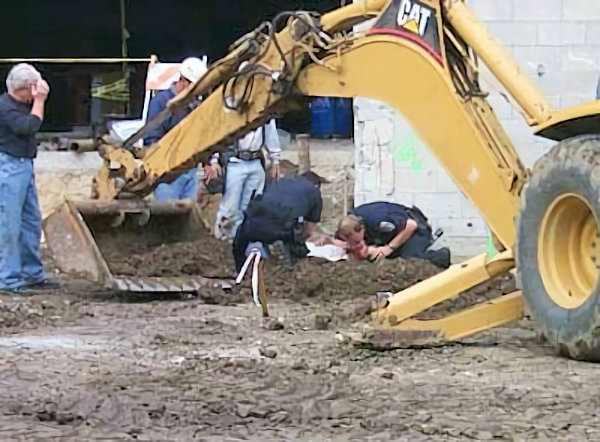
When operators are backing up or turning equipment without full visibility, they may unintentionally strike nearby workers or crash into other machines.
Struck-By Hazards
A struck-by hazard occurs when a moving object hits a worker. This includes being hit by heavy equipment, tools, or materials in motion. Struck-by incidents often happen when equipment operators do not see nearby workers.
Examples: A worker walking behind a wheel loader may be struck if the operator does not see them in the blind spot. A construction carpenter is struck by the bucket of a backhoe. (See image)
Struck-Against Hazards
A struck-against hazard happens when a worker strikes or is pushed against a stationary object. This can occur when the worker slips, trips, or is forced into fixed surfaces by moving equipment.
Example: A worker hurrying through a congested work zone unknowingly walks into the side of a stationary crane, hitting their head or shoulder on the metal structure.
Knowledge Check Choose the best answer for the question.
2-3. A laborer walks behind a wheel loader that is backing up. The operator cannot see the worker due to a blind spot and injures the laborer. Which hazard type caused the the accident?
You forgot to answer the question!