
Caught-In / Caught-Between Hazards
Working in and around heavy equipment presents serious risks, especially when workers are near moving machinery or tight spaces.
Preventing Powered Haulage Accidents
These hazards can lead to severe injuries or fatalities if proper safety procedures are not followed. Understanding the differences between them and how they happen around heavy equipment is important for maintaining a safe worksite.
OSHA and most safety professionals use the umbrella term “caught-in or caught-between” to cover any incident in which any part of a worker’s body or clothing is caught, pulled, crushed, or snagged, resulting in injury.
- Pinched or caught, or snagged between moving or stationary objects
- Compressed or crushed between two or more objects
- Crushed or pinned by collapsing materials, equipment rollover, or heavy objects
- Caught or snagged on protruding parts and drawn into machinery (unguarded belts, chain drives, etc.)
Caught-in Hazards: These types of hazard happens when a person becomes trapped inside or pulled into machinery with moving parts. It often occurs when guards are missing or the equipment is not turned off during maintenance or cleaning.
- Example: A worker reaches into a running asphalt paver to remove a blockage, gets loose clothing caught, and is pulled into the conveyor mechanism.
- Example: A worker's clothing gets caught by a rotating drill bit, pulling his arm into the machinery. The summary would classify the incident as caught-in. The resulting injuries are often fatal.
Even though the incident by getting clothing “caught-on” something, OSHA places it in the Caught-in hazard category because that is almost always the mechanism and the ultimate severe outcome (crush, amputation, crushing, strangulation, or being pulled off a height).
Caught-Between Hazards: Many incidents have occurred in work areas where workers on foot are caught between heavy equipment and fixed objects such as walls, barriers, or other equipment. These accidents often happen when the equipment does not have enough space to turn safely or when workers are standing in pinch points.
- Example: A worker guiding a truck into a narrow loading zone may become trapped between the truck and a retaining wall.
- Example: This image depicts the accident scene in which a maintenance mechanic died when he was crushed between an overhead gantry crane and a light fixture.
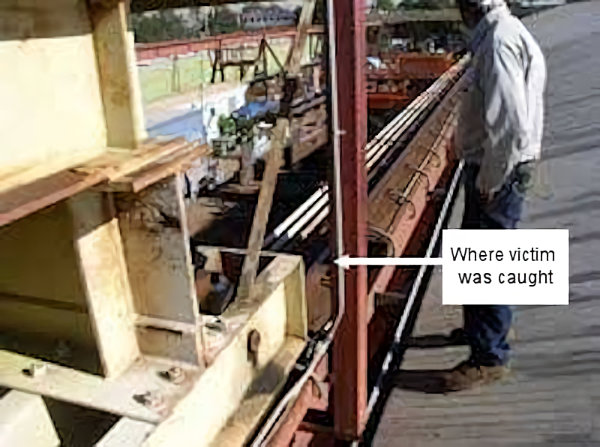
He was working on the crane’s electrical system and was positioned in a narrow space when the crane moved unexpectedly, trapping him between the crane structure and the fixed overhead light. Crush hazards are often deadly due to the force involved.
A "crush" accident is almost always categorized by OSHA as a caught-in or caught-between hazard. It is one of the leading causes of fatalities in both construction and general industry and is treated as a distinct, high-priority hazard type in OSHA training, enforcement, and fatality investigation reports.
Knowledge Check Choose the best answer for the question.
2-2. A worker standing in a narrow pathway is pinned by a rotating crane and a concrete wall. What type of hazard is this?
You forgot to answer the question!