
Written Plan Components
In companies with more than 10 employees, a fire prevention plan must be in writing, be kept in the workplace, and be made available to employees for review. Companies that have 10 or fewer employees, OSHA allows the fire prevention plan to be communicated orally.
Minimum Requirements of a Fire Prevention Plan
According to OSHA, your written fire prevention plan must include the following components:
- A list of all major fire hazards in the workplace, along with:
- Proper handling and storage procedures for hazardous materials
- Potential ignition sources and how they are controlled
- Type of fire protection equipment used for each hazard (e.g., extinguishers, sprinklers)
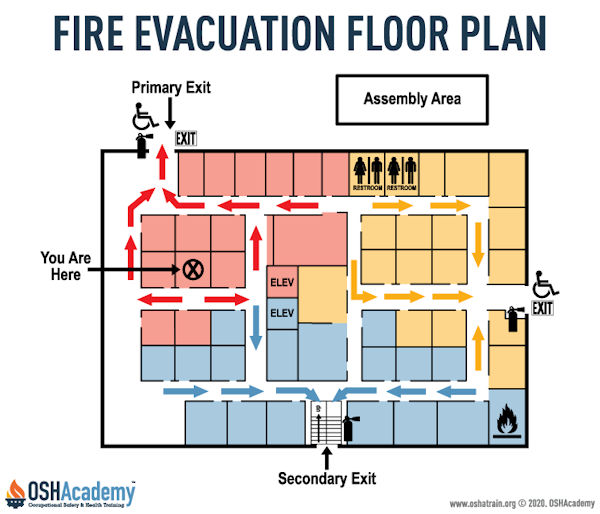
- A posted evacuation floor plan located near primary exits to help employees evacuate safely during an emergency.
- Procedures to control the buildup of flammable and combustible waste materials (e.g., oily rags, packaging).
- Procedures for regular maintenance of safeguards on heat-producing equipment (e.g., furnaces, welding torches) to prevent accidental ignition.
- The name or job title of employees responsible for:
- Maintaining equipment to prevent or control ignition sources or fires
- Managing and controlling fuel source hazards (e.g., gas lines, storage tanks)
Recommended Additions
Although not formally required by OSHA for a Fire Prevention Plan (FPP), it is strongly recommended to include elements in OSHA 1910.38 – Emergency Action Plans (see link below) to improve overall workplace fire safety and emergency preparedness.
Incorporating the elements below into your FPP can help ensure employees know how to respond quickly and safely in the event of a fire or other emergency.
- Evacuation Floor Plans: Post clearly marked evacuation maps near exits and in common areas. These maps should show:
- Primary and secondary evacuation routes
- Locations of fire extinguishers and fire alarm pull stations
- Designated assembly or meeting points outside the building
- Emergency Evacuation Procedures: Outline how and when to evacuate the building, including:
- Who is authorized to initiate evacuation
- Steps for assisting individuals with disabilities
- Procedures for accounting for employees after evacuation
- Designated Emergency Coordinators: Identify individuals responsible for leading evacuations, sounding alarms, and assisting with headcounts.
- Training and Drills: Conduct regular fire drills and employee training to ensure everyone understands the evacuation procedures and their role in an emergency.
- Employers must inform employees of any fire hazards they may be exposed to when they start a new job or move to a new location.
- Each employee must be trained on the parts of the fire prevention plan that apply to their role and responsibilities.
- Emergency Contact Information: Include phone numbers for internal emergency contacts (e.g., safety officers) and external responders (e.g., fire department, EMS).
- 1910.38(a) Application. An employer must have an emergency action plan whenever an OSHA standard in this part requires one. The requirements in this section apply to each such emergency action plan.
- 1910.38(b) Written and oral emergency action plans. An emergency action plan must be in writing, kept in the workplace, and available to employees for review. However, an employer with 10 or fewer employees may communicate the plan orally to employees.
- 1910.38(c) Minimum elements of an emergency action plan. An emergency action plan must include at a minimum:
- 1910.38(c)(1)Procedures for reporting a fire or other emergency;
- 1910.38(c)(2) Procedures for emergency evacuation, including type of evacuation and exit route assignments;
- 1910.38(c)(3) Procedures to be followed by employees who remain to operate critical plant operations before they evacuate;
- 1910.38(c)(4) Procedures to account for all employees after evacuation;
- 1910.38(c)(5) Procedures to be followed by employees performing rescue or medical duties; and
- 1910.38(c)(6) The name or job title of every employee who may be contacted by employees who need more information about the plan or an explanation of their duties under the plan.
- 1910.38(d) Employee alarm system. An employer must have and maintain an employee alarm system. The employee alarm system must use a distinctive signal for each purpose and comply with the requirements in § 1910.165.
- 1910.38(e) Training. An employer must designate and train employees to assist in a safe and orderly evacuation of other employees.
- 1910.38(f) Review of emergency action plan. An employer must review the emergency action plan with each employee covered by the plan:
- 1910.38(f)(1) When the plan is developed or the employee is assigned initially to a job;
- 1910.38(f)(2) When the employee's responsibilities under the plan change; and
- 1910.38(f)(3) When the plan is changed.
Knowledge Check Choose the best answer for the question.
1-2. When the employer has more than 10 employees, the fire prevention plan must be _____.
You forgot to answer the question!