
National Response System (NRS)
Unified Command
The Unified Command is the cornerstone for effective multi-agency incident management in the U.S., particularly critical in complex environmental responses under the NCP, ensuring collaborative, efficient, and accountable operations.
NATIONAL CONTINGENCY PLAN
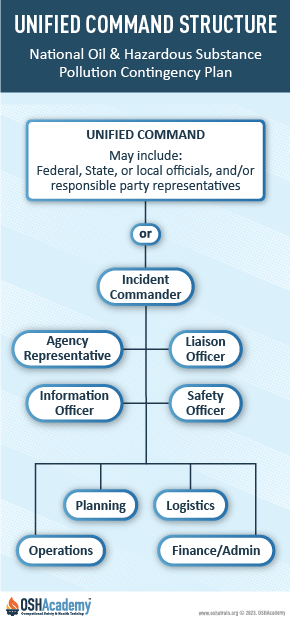
Higher levels (NRT and RRTs) provide policy guidance, planning, and support but do not directly manage on-scene tactics—those are handled through Unified Command.
The Unified Command fits at the on-scene operations level of the NRS as the primary response management structure used during actual incidents to ensure coordinated, multi-jurisdictional operations.
The NCP explicitly states that the NRS functions using the Incident Command System (ICS), with the basic framework for on-scene response management being a unified command system.
For incidents involving oil discharges or hazardous substance releases, Unified Command is the standard response management structure outlined in the NCP and NRS. The predesignated Federal On-Scene Coordinator (FOSC)—provided by the EPA (inland zone) or USCG (coastal zone)—leads the federal effort.
The Unified Command typically includes:
- Federal On-Scene Coordinator (FOSC): EPA or USCG representative.
- State Representative: Often from the state's environmental or emergency management agency (e.g., state oil spill coordinator).
- Local/Tribal Representatives: As appropriate for the jurisdiction.
- Responsible Party (RP): The entity liable for the spill (e.g., vessel owner, facility operator), if cooperative.
The FOSC retains ultimate decision-making authority for federal actions under the NCP, but the Unified Command coordinates overall response priorities, resource allocation, and strategies. Objectives include rapid containment, cleanup, and minimization of environmental/public health impacts, often funded initially by the Oil Spill Liability Trust Fund (with reimbursement from the RP).
Real-world examples include responses to major oil spills (e.g., Deepwater Horizon) and smaller incidents, where Unified Commands comprising USCG, EPA, state agencies, and the RP have been established to manage operations.
In oil spill incidents—especially those affecting U.S. waters or shorelines—a Unified Command (UC) is often established under the Incident Command System (ICS). This allows multiple agencies and organizations to coordinate their efforts while retaining their individual authority.
1. Deepwater Horizon (2010) – Gulf of America
One of the most significant oil spills in history, the Deepwater Horizon disaster released millions of barrels of oil into the Gulf of America.
Unified Command included:
- U.S. Coast Guard (USCG) – Federal On-Scene Coordinator (FOSC)
- Environmental Protection Agency (EPA)
- State agencies from Louisiana, Mississippi, Alabama, Florida, and Texas
- Responsible Party (RP): BP
The UC coordinated cleanup, environmental protection, and communication through a Joint Information Center (JIC).
2. Kalamazoo River Spill (2010) – Michigan
A pipeline rupture released over 800,000 gallons of crude oil into the Kalamazoo River.
Unified Command included:
- EPA – FOSC since it was an inland incident
- Michigan Department of Environmental Quality (MDEQ)
- Responsible Party: Enbridge
This incident highlighted the complexity of inland oil spill responses and the need for long-term environmental monitoring.
3. Refugio Beach Spill (2015) – California
A pipeline leak near Santa Barbara released over 100,000 gallons of oil into coastal waters and along the shoreline.
Unified Command included:
- USCG – FOSC for coastal waters
- California Department of Fish and Wildlife
- EPA
- Responsible Party: Plains All American Pipeline
The UC oversaw cleanup efforts, wildlife protection, and coordination between federal, state, and local responders.
Why Unified Command Matters
The examples above show how Unified Command ensures clear communication, shared decision-making, and coordinated resource use. It's a key component of the National Oil and Hazardous Substances Pollution Contingency Plan (NCP) and required under OSHA’s HAZWOPER standard (29 CFR 1910.120 ) for major emergency responses involving hazardous substances.
Knowledge Check Choose the best answer for the question.
1-5. What role does Unified Command play in multi-agency incident management in the U.S.?
You forgot to answer the question!