
Basic Lockout/Tagout Steps
Step 3: Machine or Equipment Shutdown
The machine or equipment must be turned off or shut down using the procedures established for it to avoid any additional or increased hazards to workers as a result of the unexpected machine or equipment startup or stoppage.

Step 4: Machine or Equipment Isolation
Energy-isolating devices that are needed to control the machine's energy source must be identified. These devices must then be used to isolate the machine or equipment from its energy source(s).
De-energizing equipment means isolating it from its energy source and controlling potential energy so that no energy can flow to the equipment. The method you use to de-energize equipment depends on the form of energy and the means available to control it.
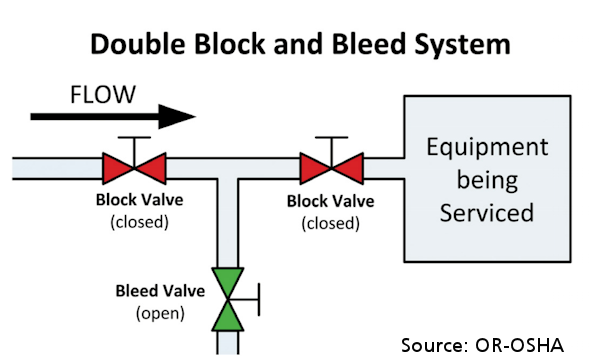
Below is a list of safe practices for de-energizing equipment.
- Disconnecting motors from the equipment
- Isolating electrical circuits
- Disconnecting equipment from energy sources
- Blocking the fluid flow in hydraulic, pneumatic, or steam systems with control valves or by capping or blanking the lines
- Blocking equipment parts that could be moved by gravity
- 1910.147(d)(2)
Machine or equipment isolation. All energy isolating devices that are needed to control the energy to the machine or equipment shall be physically located and operated in such a manner as to isolate the machine or equipment from the energy source(s).
- 1910.147(d)(3)
Machine or equipment shutdown. The machine or equipment shall be turned off or shut down using the procedures established for the machine or equipment. An orderly shutdown shall be utilized to avoid any additional or increased hazard(s) to employees as a result of the equipment stoppage.
Knowledge Check Choose the best answer for the question.
6-3. During shutdown, what must be identified and used to isolate the equipment or machine from its energy source(s)?
You forgot to answer the question!