
Installing Production Tubing
A well is usually produced by directing oil and gas through production tubing installed inside the production casing. In most wells, oil and gas flow more efficiently through the smaller-diameter tubing than through the larger-diameter casing. Here's why:
- The smaller inside diameter of the tubing increases the velocity of the produced fluids, helping carry oil, gas, and other fluids to the surface more efficiently. Higher fluid velocity also helps reduce the accumulation of liquids in the well, which can restrict production.
- Production tubing also protects the production casing from corrosion, erosion, and wear caused by produced fluids. If the tubing becomes damaged or needs replacement, it can usually be removed and replaced without removing the casing, reducing maintenance costs and extending the life of the well.
- Also, production tubing provides a controlled flow path for installing downhole equipment such as packers, safety valves, gas lift valves, pumps, and other production tools. This makes the well easier to operate, maintain, and service throughout its productive life.
Joints of tubing are joined together with couplings to make up a tubing string. Tubing is run into the well much the same as casing, but tubing is smaller in diameter and is removable.
The steps for this activity are:
- Tubing elevators are used to lift tubing from the rack to the rig floor.
- The joint is stabbed into the string, which is suspended in the well, with air slips.
- Power tongs are used to make-up tubing.
- This process is repeated until tubing installation is complete.
- The tubing hanger is installed at the wellhead.
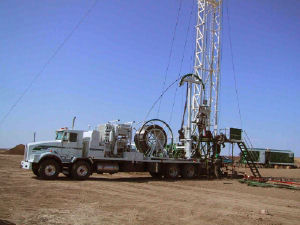
New technology allows tubing to be manufactured in a continuous coil, without joints. Coiled tubing is inserted into the well down the production casing without the need for tongs, slips, or elevators, which takes considerably less time to run.
Let's take a look at the potential hazards and possible solutions when installing production tubing in the next tab.
Potential Hazards
Roughnecks should avoid placing hands on the end of the tubing stump because the tubing can move unexpectedly during installation, creating pinch and crush hazards that can catch or severely injure the hands and fingers. Examples of possible injuries include:
- Getting pinched fingers and hands from tongs and slips
- Being struck by swinging tubing and tubing elevators
- Getting caught between the joint and tongs or stump
- Being struck by the tubing hanger wrench if it should slip
- Getting fingers and hands pinched and caught between tubing hanger and tubing head
Possible Solutions
Roughnecks can avoid these pinch and crush injuries by doing the following:
- Keep all fingers and hands away from pinch points
- Instruct workers to be on alert when on the rig floor and pipe racking area
- Avoid placing hands on the end of the tubing stump
- Use the correct tools for each task
- Inspect the tools before use
- Use coiled tubing
Knowledge Check Choose the best answer for the question.
1-5. Why is oil and gas produced through smaller-diameter tubing rather than through the large-diameter production casing?
You forgot to answer the question!