
Backhoe Safety Measures
Backhoes are powerful and versatile machines commonly used in excavation, trenching, material handling, and demolition.
Backhoe Safety
While essential for many construction and utility tasks, improper use of a backhoe can lead to serious injuries, property damage, or equipment failure. Operators and ground workers must follow strict safety procedures to prevent incidents.
General Safety Practices
- Perform a pre-operation inspection. Before using a backhoe, inspect tires, lights, fluid levels, hoses, buckets, and safety devices. Look for leaks, cracks, or worn parts that could lead to equipment failure.
- Use seat belts at all times. The operator must wear a seat belt when seated in the cab, even during short tasks. Seat belts reduce the chance of injury during tipping or sudden movement.
- Operate only from the operator’s seat. Never attempt to operate the backhoe while standing outside the cab or from the ground. All controls must be operated from the seated position inside the cab.
- Know the machine’s limits. Do not attempt to lift or move loads that exceed the backhoe’s rated capacity. Refer to the load chart or manufacturer’s guidelines.
Safe Movement and Positioning
- Lower all attachments when parked. Always lower the front loader and backhoe bucket to the ground when the machine is not in use. Engage the parking brake and turn off the engine before leaving the seat.
- Stabilize before digging. Extend the stabilizers fully before using the backhoe arm. This keeps the machine stable and prevents tipping during operation.
- Use slow, controlled movements. Avoid jerky or rapid movements with the boom or bucket. Sudden actions can cause the machine to become unstable or damage the work area.
- Keep the bucket low when moving. Travel with the front bucket low to the ground to maintain visibility and stability. Avoid carrying loads with the boom extended while traveling.
Ground Worker and Bystander Safety
- Maintain clear communication. Operators and ground workers must use hand signals or radios to communicate clearly. Never move the machine unless everyone is accounted for.
- Keep people away from swing areas. The backhoe arm and bucket can swing quickly and with great force. No one should stand within the swing radius or between the machine and a fixed object.
- Use warning signs and barriers. In high-traffic or public areas, place cones, barricades, or signs to keep pedestrians and vehicles out of the work zone.
Working Near Hazards
- Check for underground utilities. Before digging, always contact the local utility locating service to mark underground lines. Striking a gas, electric, or water line can cause serious injury or death.
- Watch for overhead hazards. Avoid working under or near power lines, trees, or other overhead obstacles. Maintain a safe clearance as required by OSHA or local standards.
- Operate with caution on slopes. Avoid traveling or digging on steep inclines. When work on slopes is necessary, position the machine with the boom on the uphill side whenever possible.
Shutdown and Maintenance
- Secure the equipment. At the end of the shift, park the backhoe on level ground, lower all attachments, engage the parking brake, and shut off the engine.
- Lock out before service. If maintenance or repairs are needed, follow lockout/tagout procedures to prevent accidental startup.
- Store attachments safely. Keep buckets, forks, or other attachments stored on level ground and in a secure area to prevent tipping or rolling.
Backhoe Operations Safety Checklist
Use this checklist before and during backhoe operations to ensure safe working conditions and procedures are being followed.
| Check (✓) | Safety Measure |
|---|---|
| Operator is trained, qualified, and authorized to use the backhoe | |
| Perform daily inspection of tires, lights, fluids, brakes, and hydraulic components | |
| Verify ground is stable and free of hazards before operating | |
| Always wear seat belt and required PPE | |
| Use outriggers to stabilize the backhoe before digging | |
| Check for overhead obstructions and underground utilities before digging | |
| Do not exceed lifting capacity shown on load chart | |
| Use proper digging techniques to avoid sudden movement or tipping | |
| Keep swing area clear of workers and other equipment | |
| Lower attachments to the ground and set parking brake before exiting | |
| Store the machine safely and secure it when not in use |
Real-life Accident
Backhoe Strikes Worker
A contractor was operating a backhoe when an employee attempted to walk between the swinging superstructure of the backhoe and a concrete wall.
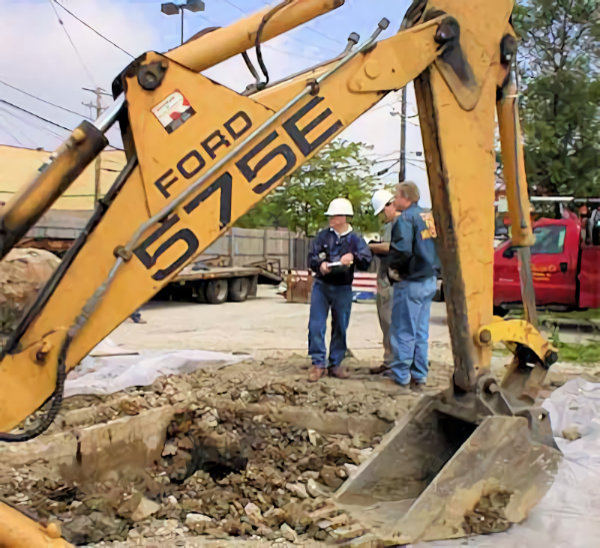
As the employee approached from the operator's blind side, the superstructure hit the victim, crushing him against the wall. Employees had not been trained in safe work practices, and no barricades had been erected to prevent employee access to a hazardous area.
Knowledge Check Choose the best answer for the question.
4-11. What is one requirement of a proper pre-operation inspection for a backhoe?
You forgot to answer the question!