
Estimating Total Accident Costs
A credible estimate of potential savings uses documented incident costs, clearly stated assumptions, and reasonable ranges. Committees should distinguish direct and indirect costs and explain that actual savings depend on the hazards, selected controls, and effectiveness of implementation.
- Insured-direct costs: These costs are usually covered by insurance premiums. They represent just the "tip of the iceberg."
- Uninsured-indirect costs: These are the underlying costs the employer pays, usually "out of pocket," for consequences not covered by insured-direct costs. They represent the part of the iceberg under water that is less visible and can be substantial.
Click below to see a list of examples of direct and indirect costs.
Direct-insured costs include:
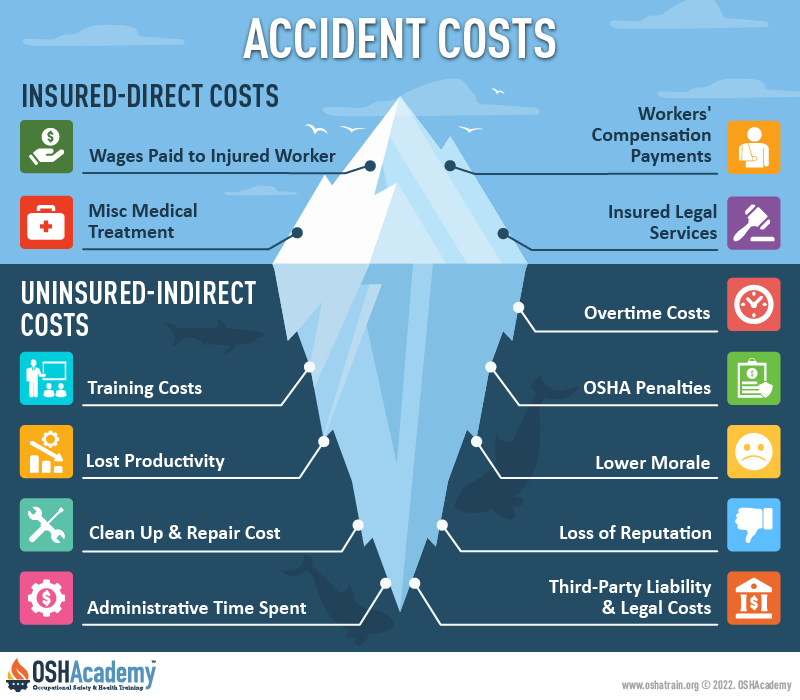
- injured worker's wages during injury
- workers' compensation payments
- medical treatment expenses
- costs for insured legal services
Uninsured-indirect costs include:
- Wages paid to injured workers for absences not covered by workers' compensation.
- Cost of wages related to time lost through work stoppage associated with the worker injury.
- Overtime costs necessitated by the injury.
- Administrative time spent by supervisors, safety personnel, and clerical workers after an injury.
- Training/retraining costs for a replacement worker.
- Lost productivity related to work rescheduling, new employee learning curves, and accommodation of injured employees.
- Damaged equipment and materials clean-up, repair, and replacement.
- Costs of accident investigations.
- OSHA fines and any associated legal action.
- Employer-paid medical, third-party liability, and legal costs.
- Worker pain and suffering.
- Loss of reputation and goodwill from bad publicity.
Indirect costs vary by injury, workplace, and business circumstances, so do not rely on a single multiplier for every incident. When possible, use the employer's actual cost data. OSHA's Safety Pays Program can also help estimate direct and indirect costs and the additional sales needed to cover them. OSHA notes that its estimator is an awareness tool, not a detailed analysis of a particular employer's costs.
So, now the question is, how much will the employer save in the future by investing now? We'll answer that question in the next section.
Knowledge Check Choose the best answer for the question.
7-6. What makes an estimate of potential safety savings credible?
You forgot to answer the question!