
Benching
There are two basic types of benching: simple and multiple. The type of soil determines the horizontal-to-vertical ratio of the benched side. Below are maximum allowable slope and angle requirements for Type A, B, and C soils. For more information, see OSHA 1926 Subpart P, Appendix B .
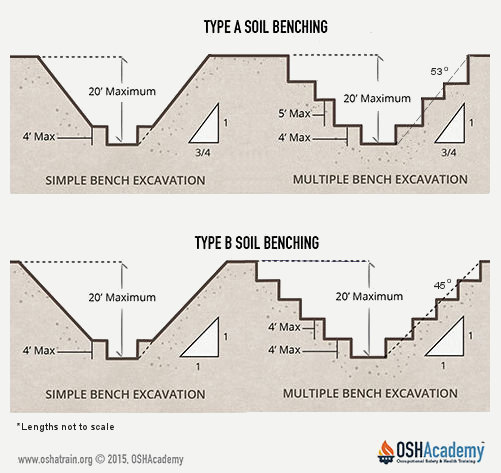
The requirements for benching in Type A and B soils are different.
- The bottom vertical height of the trench must not exceed 4 feet.
- Subsequent benches may be up to a maximum of 5 feet vertical in Type A soil and 4 feet in Type B soil.
- All subsequent benches must be below the maximum slope allowed for that soil type.
- A short-term (24 hours or less) maximum allowable slope of 1/2H:1V (63º) is allowed in excavations in Type A soil that are 12 feet (3.67 m) or less in depth. The maximum allowable slope for excavations greater than 12 feet (3.67 m) in depth is 3/4H:1V (53º).
- In Type B soil, the trench excavation is permitted only in cohesive soil that sticks together when compacted.
- Type C soil is the most common type of soil in most urban and suburban areas. It may have been reworked and is not stable enough for benching as a protective system; use sloping instead.
Knowledge Check Choose the best answer for the question.
2-7. In which soil types may benching be used as a protective system?
You forgot to answer the question!