
Benching Systems
There are two basic types of benching: simple and multiple. The soil type determines the horizontal to vertical ratio of the benched side.
Can this soil be benched?
Below are benching requirements for Type A, B, and C soils.
- The bottom vertical height of the trench must not exceed 4 feet.
- Subsequent benches may be up to a maximum of 5 feet vertical in Type A soil and 4 feet in Type B soil.
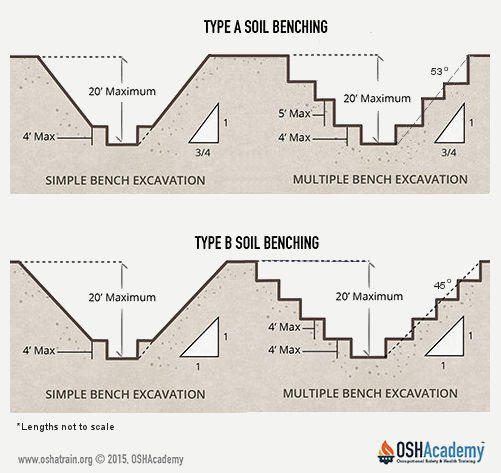
Subsequent benches must be a maximum of 5 feet vertical in Type A soil and 4 feet in Type B soil.
- All subsequent benches must be below the maximum slope allowed for that soil type.
- A short-term (>24 hrs) maximum allowable slope of 1/2H:1V (63º) is allowed in excavations in Type A soil that are 12 feet (3.67 m) or less in depth. Short-term maximum allowable slopes for excavations greater than 12 feet (3.67 m) in depth must be 3/4H:1V (53º).
- In Type B soil, the trench excavation is permitted only in cohesive soil that sticks together when compacted.
- Benching is not specified for Type C soils unless engineered—so relying solely on benching in Type C soil would not meet the standard unless a registered professional engineer designs a protective system.
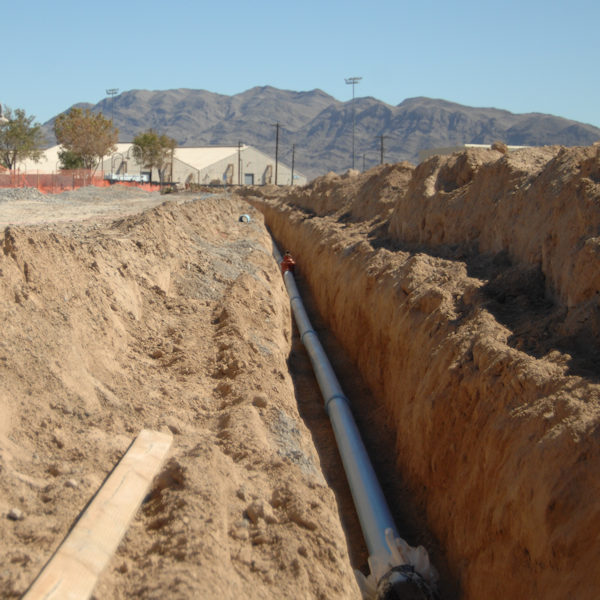
Refer to the image on this page. Based on the criteria above, is benching allowed for the excavation? Click on the image to see the answer.
See Appendix B, Fig. B-1.1 and B-1.2 for detailed simple and multiple bench configurations in Class A and B soils.
Knowledge Check Choose the best answer for the question.
4-3. As a general rule, the bottom bench vertical height of a multiple-benched trench must not exceed _____.
You forgot to answer the question!