
Ventilation in Confined Spaces
A confined space is generally defined as a space such as a relatively small or restricted space such as a tank, boiler, pressure vessel, or small compartment of a ship. Ventilation is a prerequisite to work in confined spaces.
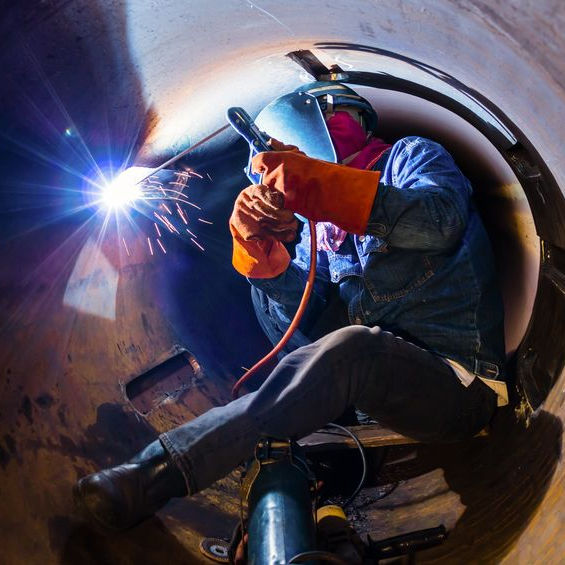
Providing adequate ventilation for welders in confined spaces poses several challenges due to the nature of the environment and the specific hazards involved. Below is a summary of OSHA 1910.252(c)(4), requirements for ventilation in confined spaces.
Air Replacement: All welding and cutting operations in confined spaces must be adequately ventilated to prevent the accumulation of toxic materials or possible oxygen deficiency. This applies not only to the welder but also to helpers and other personnel in the immediate vicinity. All air replacing that withdrawn must be clean and respirable.
Airline Respirators: In circumstances for which it is impossible to provide adequate ventilation, airline respirators or hose masks approved for this purpose by the National Institute for Occupational Safety and Health (NIOSH) under 42 CFR part 84 must be used.
Self-contained Units: In areas immediately hazardous to life and health (IDLH), a full-facepiece, pressure-demand, self-contained breathing apparatus or a combination full-facepiece, pressure-demand supplied-air respirator with an auxiliary, self-contained air supply approved by NIOSH under 42 CFR part 84 must be used.
Outside Helpers: These workers are responsible for ensuring the safety of those working inside. When welding is performed in confined spaces and welders or helpers use hose masks, hose masks with blowers, or SCBA equipment approved by MSHA and NIOSH, an attendant must be stationed outside the space.
Securing Cylinders and Machinery: Locate gas cylinders and welding machines on the outside when welding or cutting in any confined space. Securely block heavy portable mounted equipment before starting operations to prevent accidental movement.
Oxygen for ventilation: Oxygen must never be used for ventilation.
Fluorine compounds: A fluorine compound is one that contains fluorine, as an element in chemical combination, not as a free gas. Proper protection is desirable for fixed-location production welding and for all production welding on stainless steels. Where air samples taken at the welding location indicate that the fluorides liberated are below the maximum allowable concentration, such protection is not necessary.
Lifelines: If a welder must enter a confined space through a manhole or other small opening, you must provide a way to quickly remove the welder in an emergency.
Key Largo Collapse
- Attach safety belts and lifelines to the welder so his body cannot be jammed in a small exit opening.
- Place an attendant with a pre-planned rescue procedure outside to observe the welder at all times and be capable of putting rescue operations into effect.
Electrode Removal: When suspending arc welding for any substantial period, such as during lunch or overnight, remove all electrodes from the holders. The holders should be carefully located so that accidental contact cannot occur, and the machine should be disconnected from the power source.
Gas Cylinder Shutoffs: In order to eliminate the possibility of gas escaping through leaks of improperly closed valves:
- Close the torch valves
- Completely shut off the fuel-gas and oxygen supply to the torch at some point outside the confined area
- Remove the torch and hose from the confined space when it is practicable
Warning Signs: After completing the welding, the worker must mark the hot metal or provide some other means of warning other workers.
Torch Valves: It is important to eliminate the possibility of gas escaping through leaks or improperly closed valves. If the torch will be unused for a long time (i.e., overnight), close the torch valves. Shut-off the gas supply to the torch at some point outside the confined area. When necessary, remove the torch and hose from the confined space.
Knowledge Check Choose the best answer for the question.
5-5. What equipment should be used when proper ventilation cannot be provided in a confined welding space?
You forgot to answer the question!