
Portable Ladders
Straight or Single Ladders
The most common type of portable ladder is a straight or single ladder.

It is a non-self-supporting portable ladder that is non-adjustable in length, consisting of one section. Unlike a stepladder that requires level support for all four of its side rails, the Single Ladder requires only two level ground support points in addition to a top support. Ladder levelers may be used to achieve equal rail support on uneven surfaces. (American Ladder Institute)
- It is intended for use by one person.
- The length cannot exceed 30 feet.
- It is available in wood, metal and reinforced fiberglass.
- It supports only one worker.
- The top support allows tie off the top of the ladder to increase stability.
Extension Ladders
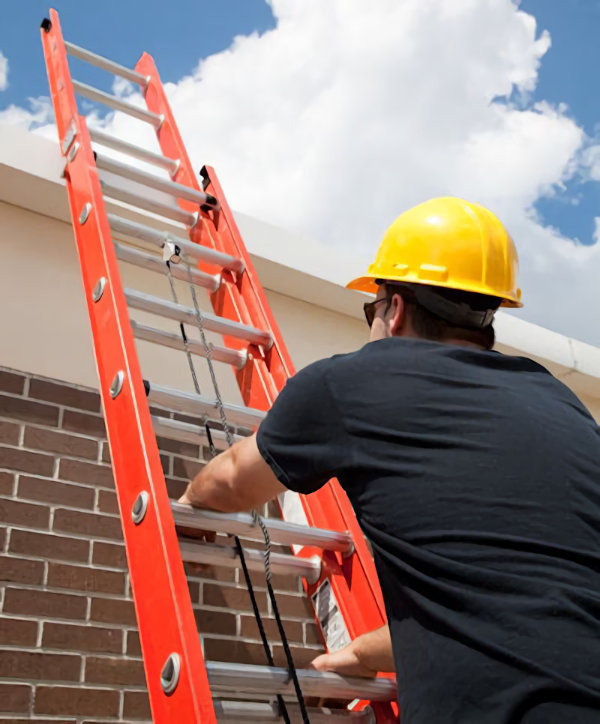
We use ladders to do all sorts of tasks, so it's not surprising that many types of ladders are available. Let's look at the most common types. Characteristics of extension ladders include:
- They offer the most length in a general-purpose ladder.
- They have two or more adjustable sections.
- The sliding upper section must be on top of the lower section.
- They are made of wood, metal, or fiberglass.
- The maximum length of extension depends on material
- They support only one worker.
It's important to choose the right ladder for the right job. Using a ladder for a task that it was not designed for may increase the risk of falling.
Oregon OSHA inspected a residential construction site where two-story framing work was underway. Inspectors found workers relying on portable ladders for access and task support, but basic safety requirements were not being followed. In particular, a ladder used to reach an upper landing did not extend at least three feet above the landing, increasing the risk of a fall during mounting and dismounting. Inspectors also documented a defective ladder with a broken anti-slip device still being used instead of being removed or tagged out.
These issues were consistent with broader jobsite control failures observed during the inspection, including fall protection lapses, an unprotected wall opening, and missing eye protection during tool use. No injuries were reported, but Oregon OSHA determined the hazards presented a high likelihood of serious injury or death if conditions continued.
Where ladder selection and setup failed:
- Straight/single ladders are common in construction but are non-self-supporting and depend on stable ground support plus a top support. If rails aren’t level, stability drops fast—especially on uneven terrain without levelers.
- Extension ladders must be set up correctly, with the sliding upper section on top of the lower section and the ladder extended at least 3 feet above the landing for safe access.
- Using the wrong ladder type—or using the right type incorrectly—turns “routine access” into a fall event waiting to happen.
Violations & penalties (as cited):
- Fall protection failure (repeat offense): No protection for work 6+ feet above a lower level. Penalty: $110,309
- Ladder side rails too short (repeat offense): Rails did not extend at least 3 feet above landing. Penalty: $13,800
- Unprotected wall opening: No guardrails/covers around a second-floor opening. Penalty: $1,412
- Use of defective ladder: Ladder with broken anti-slip device remained in use. Penalty: $1,412
- Lack of eye protection: Pneumatic nail gun used without required eye protection. Penalty: $1,412
Total penalties: $128,345 (adjusted based on company size).
Recommendations to prevent a repeat:
- Choose the ladder designed for the task (straight/single vs. extension) and never use one outside its intended purpose.
- For access to an upper landing, ensure ladder side rails extend at least 3 feet above the landing and secure the ladder as needed.
- Use levelers when working on uneven ground to maintain equal rail support.
- Inspect ladders before use; remove damaged ladders from service immediately and tag them out.
- Back ladder safety with supervision: if basic rules aren’t enforced, people will cut corners.
Source: Oregon OSHA News Release 2025-17
Knowledge Check Choose the best answer for the question.
4-2. How many workers will a standard straight ladder support?
You forgot to answer the question!