
Soil Mechanics
Heaving or Squeezing
Bottom heaving or squeezing is caused by the downward pressure created by the weight of adjoining soil.
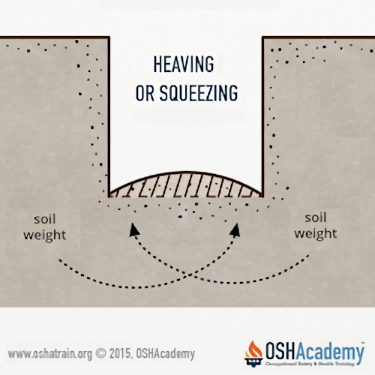
The weight of adjoining the trench can increase greatly when the soil is wet and it will expand. The expansion increases soil pressure and is a primary cause for the floor of the excavation heaving upward. because there is far less downward pressure under the trench floor. It's a battle of relative pressures. The much greater soil pressure adjoining the trench will cause the uplift in the trench floor.
Heaving and squeezing can occur even when shoring or shielding has been properly installed.
Boiling
Boiling is evidenced by an upward water flow into the bottom of the cut. A high water table is one of the causes of boiling.
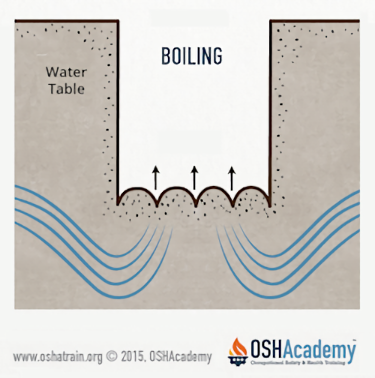
Boiling produces a "quick" condition in the bottom of the cut and can occur even when shoring or trench boxes are used.
Heads Up: Trenching and excavation remain among the most dangerous construction activities. After a sharp increase to 39 worker fatalities in 2022, OSHA's enhanced enforcement and outreach efforts helped reduce trench collapse deaths to 15 in 2023. Preliminary data show 12 trench collapse fatalities in 2024, but every one of these deaths was preventable with proper protective systems, such as sloping, shoring, or shielding.
Knowledge Check Choose the best answer for the question.
1-4. What causes bottom heaving or squeezing in a trench?
You forgot to answer the question!