
Rated Capacity and Load Center
Capacity Plate
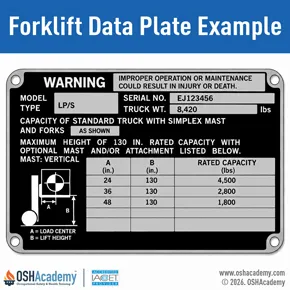
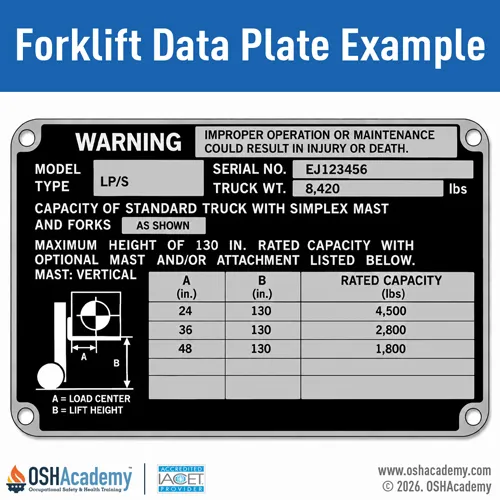
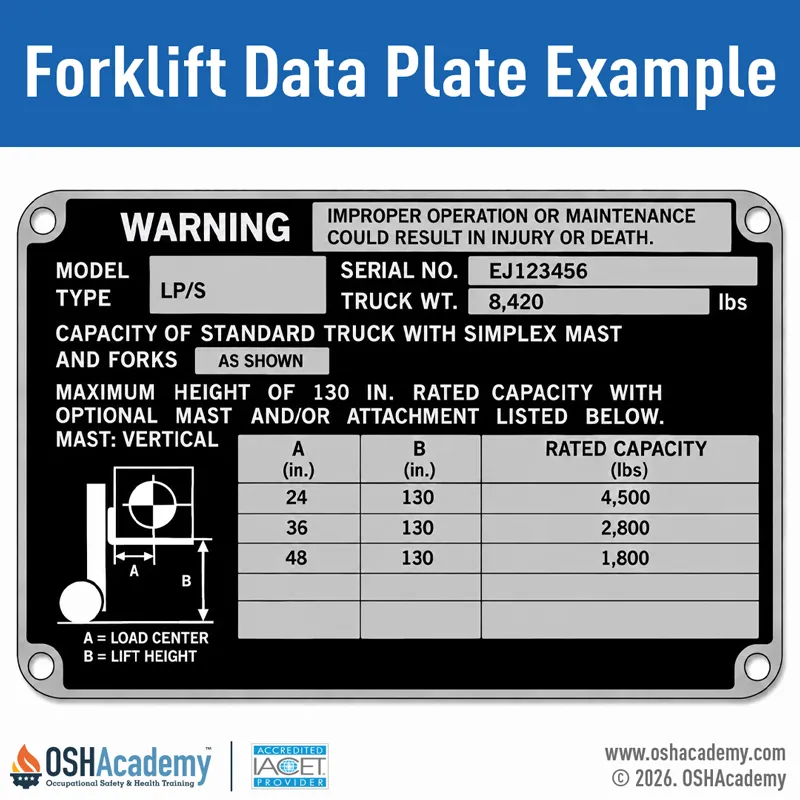
In practice, operators use the forklift's capacity plate, also called a data plate, to determine whether a load is within the truck's rated capacity under the conditions specified on the plate.
Capacity Data Plate
Load Center
A key part of the capacity rating is the load center. The load center is the horizontal distance from the vertical face of the forks or attachment to the load's center of gravity.
For a uniformly distributed load, the load center is generally half the load dimension measured from the vertical face of the forks toward the load. For example, a 48-inch-long load positioned against the fork face has a 24-inch load center.
A forklift may be rated on its capacity plate to handle 4,500 pounds at a 24-inch load center. That does not mean the forklift can handle every 4,500-pound load. A longer load with its center of gravity farther from the fork face creates greater leverage and may exceed the forklift's rated capacity. The rated capacity of the forklift decreases as the length of the load increases.
In Practice: Using the Capacity Plate
Operators should use the forklift's capacity plate and applicable manufacturer's capacity information rather than calculating load moment to determine whether a load is within the forklift's rated capacity. The moment relationships discussed on the previous page help explain the principles of forklift stability and why increasing the load weight or load-center distance can reduce stability.
Before lifting a load, the operator should:
- Determine the load weight. Check shipping documents, markings, labels, or other reliable information. Do not guess the weight of an unknown load.
- Determine the load center. Determine where the load's center of gravity is located in relation to the vertical face of the forks or attachment. For a uniformly distributed load, the load center is generally half the load dimension measured from the fork face toward the load.
- Check the capacity plate. Compare the load's weight and load center with the forklift's rated capacity and load center shown on the plate.
- Check the truck's configuration. Make sure the capacity information applies to the forklift as it is currently configured. Attachments, such as side shifters or clamps, can affect capacity. Check the capacity information applicable to the truck and attachment combination. Under 29 CFR 1910.178(a), modifications or additions that affect capacity or safe operation involve manufacturer approval and corresponding changes to plates/tags/decals, and trucks equipped with non-factory-installed front-end attachments have specific marking requirements.
- Consider the load's position and shape. Long, irregular, off-center, or unevenly distributed loads can have a different center of gravity and can affect the forklift's capacity and stability.
- Do not exceed the rated capacity. If the load or operating condition does not match the capacity information shown on the plate, do not assume the forklift can handle it. Obtain the applicable manufacturer's capacity information before lifting.
Knowledge Check Choose the best answer for the question.
1-5. An operator is unsure whether a forklift with an attachment can safely lift a load. What is the best action?
You forgot to answer the question!