
Principles of Lifting Loads
A forklift operates according to several important stability principles that operators should understand: the fulcrum principle, center of gravity (CG), stability triangle, and moment.
Fulcrum Principle
The fulcrum principle can be illustrated by comparing a forklift to a playground seesaw. The load on the forks creates a force on one side of the fulcrum, while the weight of the forklift and its counterweight create an opposing force on the other side.
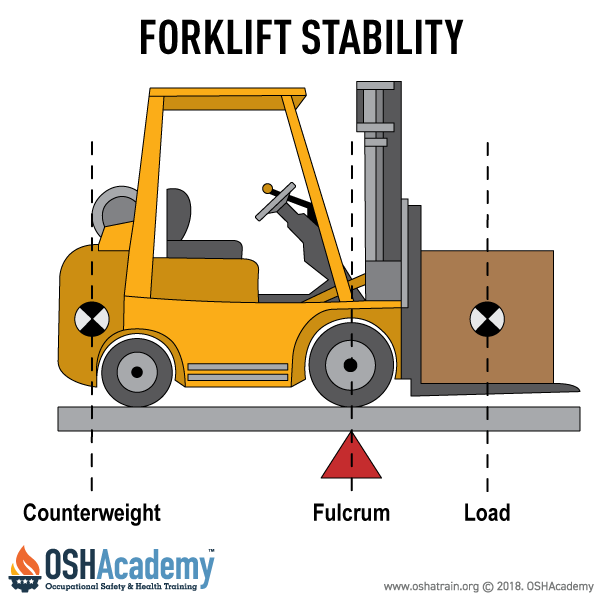
The fulcrum is the truck's axis of rotation when it tips over. During a forward tip, the forklift rotates around the line through the points where the front wheels contact the ground. The forklift's weight and counterweight help balance the load carried on the forks.
Center of Gravity (CG)
The center of gravity (CG) is the point at which an object's weight can be considered concentrated. An unloaded forklift has its own CG, and a load has its own CG. When the forklift picks up a load, the forklift and load form a combined system with a new combined center of gravity.
The position of the combined CG changes with the weight and position of the load. As a load is moved forward or raised, the combined CG also shifts. The location of the combined CG is an important factor in determining forklift stability.
Stability Triangle
Most counterbalanced powered industrial trucks have a three-point suspension system. This means the truck is supported at three points, even though it may have four wheels.
Stability Triangle
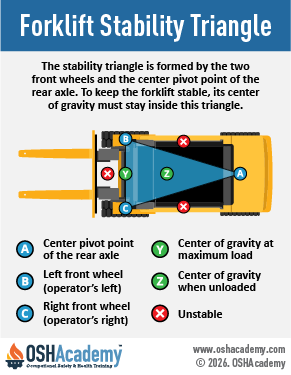
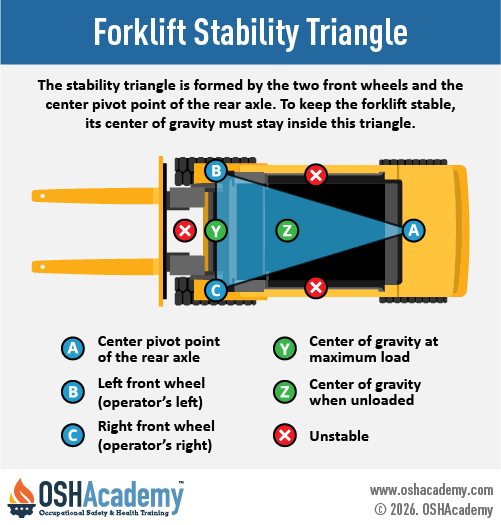
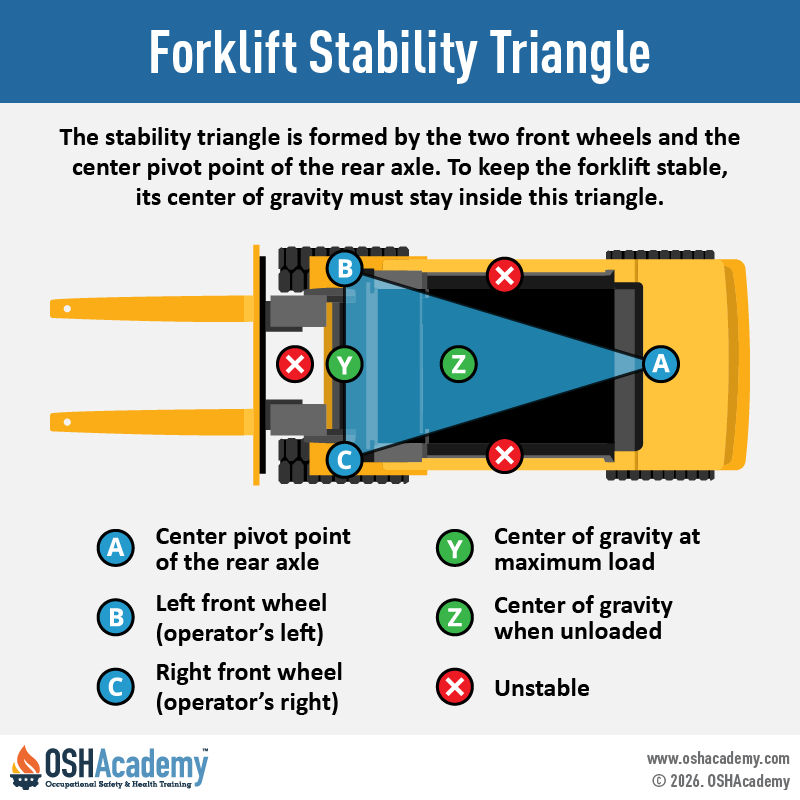
The two front wheels form two points of the stability triangle. The third point is the pivot point at the center of the rear steer axle. When these three points are connected with imaginary lines, they form the stability triangle.
Line of Action: For the safety triangle, the line of action is an imaginary vertical line extending through the combined center of gravity (CG) to the ground. For the forklift to remain stable, this line of action must remain within the applicable stability triangle boundaries.
The location of the combined CG changes as the forklift handles a load. For example, a heavier load or a load positioned farther forward shifts the combined CG toward the front of the stability triangle. Raising or tilting a load can also change the combined CG. Turning, accelerating, braking, traveling on a slope, or operating on uneven surfaces can affect the line of action and forklift stability.
Stability Pyramid:
The stability triangle represents the forklift's support area at ground level, but forklift stability is three-dimensional. One way to visualize this is to imagine a stability pyramid extending upward from the stability triangle.
Stability Pyramid
As the pyramid extends upward, its boundaries become narrower. This illustrates an important stability principle: as the combined CG rises, there is less room for its line of action to move before reaching a stability boundary.
One way to understand how a forklift's stability pyramid affects stability is to visualize a child riding a tricycle, which has a similar stability structure. If the child turns the tricycle too sharply, the combined center of gravity (CG) of the child and tricycle may move outside the stability boundaries, causing the tricycle to tip over.
Line of Action: For the stability pyramid, the line of action must remain within the boundaries of the stability pyramid which narrow as the elevation of the combined CG rises.
This is why operators should travel with the load lowered to the appropriate traveling position rather than elevated. An elevated load raises the combined CG and reduces the margin for movement before a stability pyramid boundary is reached. Turning, braking, accelerating, traveling on slopes, or traveling over uneven surfaces can further affect stability. If the line of action moves outside the applicable stability boundary, the forklift can tip over.
Knowledge Check Choose the best answer for the question.
1-3. What is the point at which the weight on both sides of a fulcrum is equal?
You forgot to answer the question!