
Indoor and Outdoor Exit Routes
In OSHA's rules for exit routes (29 CFR 1910.36 and 29 CFR 1910.37) , a dead-end refers to a portion of an exit route (usually a corridor or hallway) that has only one direction of travel toward the exit, with no exit door or other way out at the far end. If employees walk into that portion and it is too long, they could be trapped by fire or smoke with no alternative way out.
- An indoor exit route in non-sprinklered buildings must be generally less than or equal to 20 ft (very strict).
- An indoor exit route in fully sprinklered buildings must be less than or equal to 50 ft (1910.36(g)).
- An outdoor exit route must not have a dead-end that is longer than 20 feet (6.2 m).
- An outdoor exit route must have guardrails to protect unenclosed sides if a fall hazard exists.
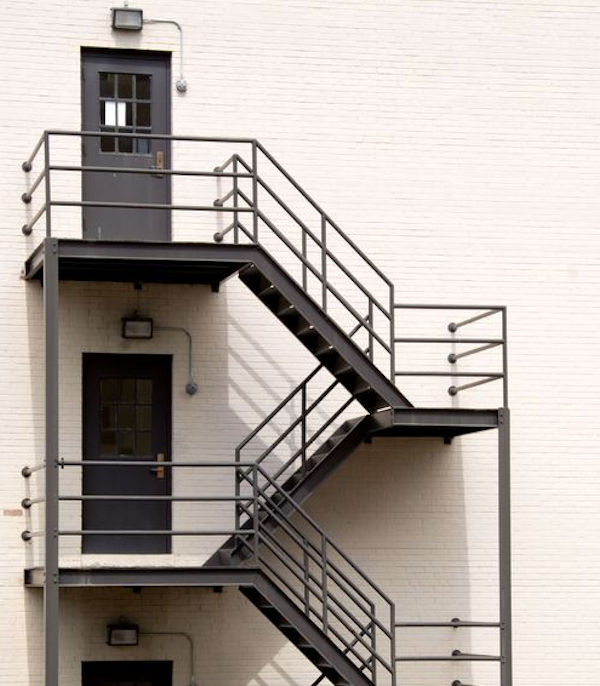
Exit doors must open out - in the direction of exit travel.
- An outdoor exit route should be covered if snow or ice is likely to accumulate along the route, unless the employer can demonstrate that any snow or ice accumulation will be removed before it presents a slipping hazard.
- The outdoor exit route should be reasonably straight and have smooth, solid, substantially level walkways.
Examples
- Classic indoor dead-end corridor (prohibited if >20 ft): Imagine a long office hallway that is 65 feet deep. You walk in from the main corridor, pass several offices on both sides, but at the far end there is only a blank wall or a janitor’s closet—no exit sign, no door leading outside or to a stairwell. This is a prohibited dead-end corridor because it is longer than 20 ft (actually 50 ft is the absolute maximum allowed in sprinklered buildings under 1910.36(g), and 20 ft in non-sprinklered buildings in many cases).
- Outdoor exit route dead-end: An exterior walkway along the side of a warehouse leads employees away from the building to a public way. The walkway is open on one side but fenced on the other. At the far end it stops at a chain-link fence with no gate. If that fenced-in portion is longer than 20 feet (6.2 m), it violates 1910.37(b)(4) because employees could be trapped against the fence if fire blocks the way back.
- Acceptable short dead-end (≤20 ft): A 15-foot-long corridor that branches off the main exit access corridor and ends with two small offices and a blank wall. Because it is only 15 ft deep, it is allowed (in a fully sprinklered building the limit can actually be up to 50 ft, but 20 ft is the conservative default many designers use).
Knowledge Check Choose the best answer for the question.
2-8. The outdoor exit route should _____.
You forgot to answer the question!