
Outdoor Walking Surface Irregularities
Poorly maintained, uneven ground, protruding structures, holes, rocks, leaves, and other debris can cause employees to stumble, trip, slip, or fall.
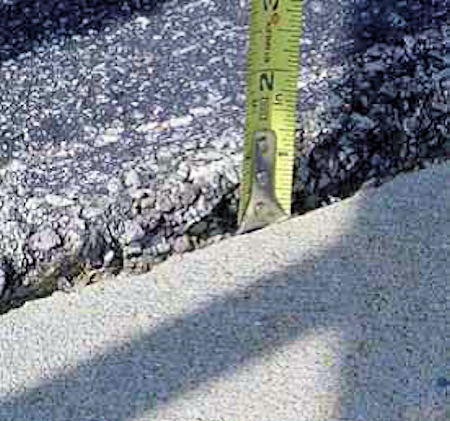
OSHA 29 CFR 1910.22 is a performance-based standard that states walking-working surfaces (including floors, sidewalks/paths used by employees) must be kept clean, orderly, sanitary, and free of hazards (e.g., sharp/protruding objects, loose boards, spills, snow/ice, or uneven conditions that could cause slips/trips/falls).
It requires regular inspections, prompt correction/repair of hazards, or guarding (e.g., barricades) if repair isn't immediate. No specific numerical thresholds (e.g., no exact inch measurement for cracks or elevation changes). Hazards are evaluated case-by-case based on risk.
Prevention Strategies
Although OSHA does not state an exact measurement, the Americans with Disabilities Act (ADA) and the American National Standards Institute (ANSI) Accessibility Standards ANSI/ASSP A1264.1 / A1264.2 consider changes in level up to 1/4 inch are allowed vertically without treatment. Between 1/4 inch and 1/2 inch, the edge must be beveled (sloped no steeper than 1:2). Over 1/2 inch, it requires a ramp.
Many sources (including safety checklists, concrete repair companies, and municipal guidelines) treat vertical changes of 1/4 inch or more as a trip hazard requiring prompt repair to avoid liability and comply with general safety expectations.
For horizontal crack width (gaps without height difference), 1/2 inch is often the limit for openings/gaps under ADA (to prevent wheelchair casters from catching), but vertical displacement is the bigger concern for trips.
- Repair any change (e.g., cracked, uneven, or raised sidewalk sections) in elevation of 1/4 inch (0.25 inches) or more.
- Repair any horizontal crack or gap greater than 1/2 inch (0.5 inches) or more.
- Create visual cues. Highlight changes in curb or walkway elevation with Safety Yellow warning paint.
- Concrete wheel stops in parking lots can be a tripping hazard and should not be used.
- Remove stones and debris from walking surfaces.
- Ensure that underground watering system structures are covered or highlighted.
Knowledge Check Choose the best answer for the question.
1-7. You should repair changes in elevation in walkways greater than _____.
You forgot to answer the question!