
Loading and Unloading the Forklift
Check out the destination:
- Is the destination flat and stable or will the load rock, tilt, or lean?
- Never place heavy loads on top of light loads.
- Observe maximum stacking quantities and orientation if printed on cartons.
- Do you know the load bearing capacity of your rack or storage loft destination?
- Are rack legs or support members bent or disconnected? The load bearing capacity of a damaged rack is unknown. Wait until the damaged component has been replaced before loading.
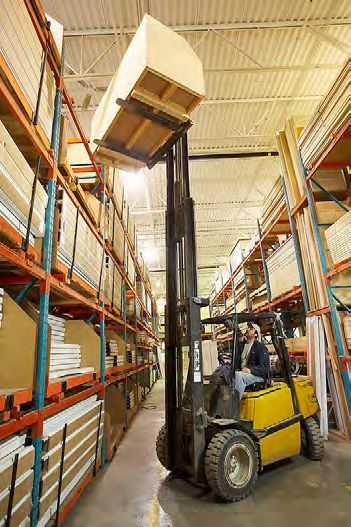
- Are racks arranged back to back with a stock behind where you will place the load? Someone may need to be in the next aisle to control access while you place the load.
- Are wooden stringers or decking laid between front and rear rack beams in good condition? They may support the load if the pallet is not properly placed on both front and rear rails.
- If you are stacking, are other pallets in the stack in good condition and capable of supporting the load in addition to what they are already supporting?
Tilt the mast backward slightly to stabilize the load and lift. Check the destination before you place the load.
- Move squarely into position in front of the rack or stack where the load will be placed.
- When ready to place the load, tilt the mast to level. Only tilt forward when the load is over the spot where it will be placed.
- Lower the forks and back away.
- Visually verify that the load is stable.
Workplace Safety Incident Summary — Oregon OSHA Enforcement (December 2025) with Rack/Forklift Controls
Situation / Event Description:
During an Oregon OSHA inspection at a manufacturing facility, officials identified serious hazards tied to how heavy raw materials were stored and handled. Industrial storage racks were found to be improperly installed and maintained: multiple baseplates were not anchored to the floor, some components were damaged, and others were installed incorrectly. Materials were stored high on these racks and accessed by employees both manually and with forklifts—creating clear struck-by and crushing hazards if racks shifted, failed, or if loads became unstable.
Inspectors also found a belt sander with unguarded moving parts, exposing workers to hand and finger injury risks.
Injuries or Fatalities:
No injuries or fatalities were reported in the release. However, unsecured racks and high-stacked heavy materials are the exact conditions that commonly lead to catastrophic outcomes—rack collapse, falling loads, or workers being struck or pinned.
Enforcement Action and Penalties:
Oregon OSHA determined the employer willfully violated safety requirements by knowingly leaving faulty storage systems in service. A second violation was issued for the unguarded machine hazard. The employer was ordered to correct the hazards and fined $28,478 total.
What Safe Practice Should Have Looked Like (Rack + Forklift Controls):
This case reinforces that “storage” is not passive—it’s an active hazard area. The following checks should have been mandatory before storing heavy materials at height or using forklifts to place loads:
Rack / Storage Destination Checks
- Confirm the rack is flat and stable—not able to rock, tilt, or lean.
- Verify baseplates are anchored and structural components are intact before loading.
- Do not load racks with bent uprights, damaged beams, missing anchors, or disconnected supports—capacity becomes unknown until repaired.
- Know the rack’s load rating and follow stacking height/orientation limits; never exceed posted capacity.
- Never place heavy loads on top of lighter/unstable loads.
- Ensure decking/stringers (if used) are intact and pallets are properly seated on both rails.
- Control adjacent aisles when loading back-to-back racking so no one is exposed to falling material behind the placement zone.
Forklift Load Placement Practices
- Stabilize the load: travel with the mast slightly tilted back.
- Square up to the rack before lifting/placing; don’t place loads at an angle.
- Level the mast only when the load is positioned over the placement spot; tilt forward only to set the load.
- Lower forks fully, back away, and visually verify the load is stable and properly supported.
Machine Guarding Control
- Guard all moving parts on tools like belt sanders to prevent entanglement and pinch-point injuries.
Bottom Line:
This wasn’t “bad luck.” It was preventable. When rack anchoring, rack condition, load limits, and forklift placement discipline aren’t enforced, the workplace becomes one shift away from a struck-by or crushing injury. The image checklist is the practical layer that should sit underneath every storage and forklift operation—every time.
Knowledge Check Choose the best answer for the question.
2-10. Which of the following is an important consideration when checking the destination of a forklift load?
You forgot to answer the question!