
Hazard Prevention and Control
Hazard prevention and control processes are conducted after hazards are identified and assessed.
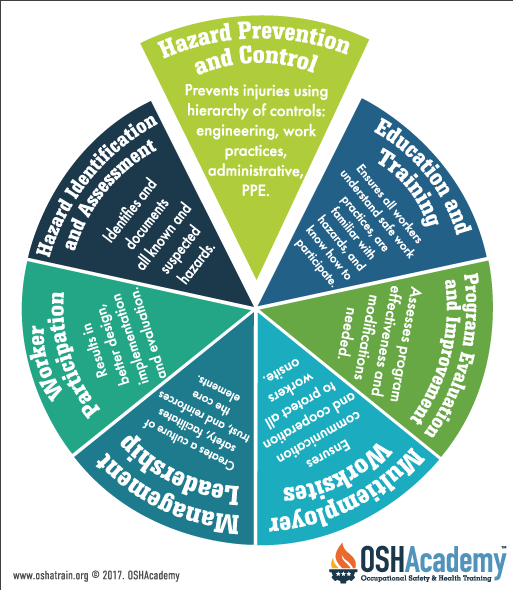
These processes help employers prevent existing and potential hazards and eliminate or otherwise control hazards in the workplace.
- Employers and workers cooperate to identify and select methods for eliminating, preventing, or controlling workplace hazards.
- Controls are selected according to the "Hierarchy of Controls" to control hazards through elimination, substitution, or engineering. Elimination is always the first priority to control hazards. If the first three control methods are not adequate to protect employees, warnings, administrative/work practice controls, and finally personal protective equipment (PPE) are also used. Ultimately, a combination of control methods is needed to adequately protect employees.
- Plans are developed to ensure controls are implemented, interim (temporary) protection is provided, progress is tracked, and the effectiveness of controls is verified.
Effective hazard prevention and control methods protect workers and have the following benefits:
- Eliminate or reduce workplace hazards.
- Help avoid injuries, illnesses, and incidents.
- Minimize or eliminate safety and health risks.
- Help employers provide workers with safe and healthful working conditions.
Repeated Hazards can still lead to Enforcement Action
A follow-up OSHA inspection at two stone-product manufacturing employers found that workers were still being exposed to respirable crystalline silica and excessive noise after similar hazards had already been identified in earlier inspections.
OSHA said the employers had not fully corrected key deficiencies, including missing written respiratory protection programs, silica exposure-control plans, and hazard communication programs. The employers were fined, reinforcing that known hazards must be corrected fully rather than addressed only partially or temporarily. Lessons learned: Repeated exposure hazards and missing safety programs can continue putting workers at risk. When known problems are not fully corrected, the result can be both ongoing worker exposure and enforcement actionKnowledge Check Choose the best answer for the question.
1-5. What is the first priority in the "Hierarchy of Controls" to prevent hazards in the workplace?
You forgot to answer the question!