
Hazard Communication Standard Application
The HCS applies to any chemical known to be present in the workplace in a way that may expose employees under normal conditions of use or in a foreseeable emergency.
Let's take a closer look at some of the components of this statement.
"Foreseeable emergency" means a potential occurrence, such as equipment failure, a container rupture, or control-equipment failure, that could result in an uncontrolled release of a hazardous chemical into the workplace.
The phrase "known to be present" is important. If a hazardous chemical is known to be present by the chemical manufacturer or the employer, it is covered by the standard.
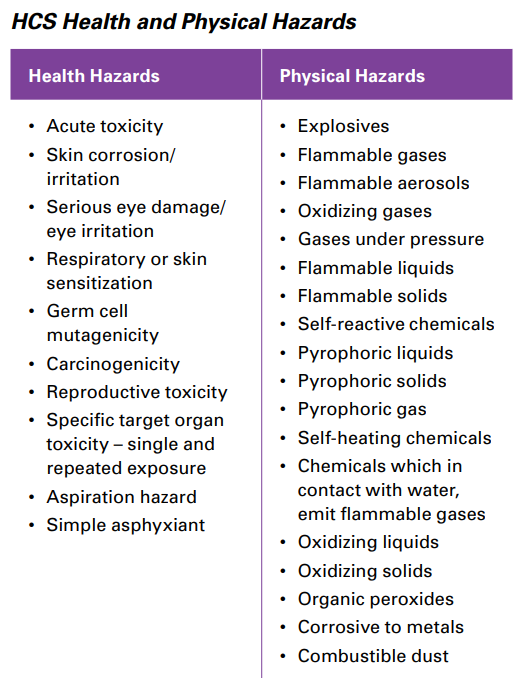
"Hazardous chemical" means a chemical classified as a physical hazard or health hazard, a simple asphyxiant, combustible dust, or a hazard not otherwise classified. The 2024 HCS also includes updated physical-hazard criteria for aerosols and flammable gases and adds classifications for chemicals under pressure and desensitized explosives.
Some products are excluded from HCS coverage under specific conditions. For example, a consumer product is excluded only when workplace use results in exposure that is no greater in duration and frequency than ordinary consumer use. Employers should evaluate how products are actually used rather than relying only on the product type.
Knowledge Check Choose the best answer for the question.
1-3. The HCS applies to a hazardous chemical known to be present when employees _____.
You forgot to answer the question!